RH Rising India Opportunities AIF is Now Live!
Know More
RH Rising India Opportunities AIF is Now Live!
Know More
RH Rising India Opportunities AIF is Now Live!
Know More
RH Rising India Opportunities AIF is Now Live!
Know More
RRH Rising India Opportunities AIF is Now Live!
Know More
RH Rising India Opportunities AIF is Now Live!
Know More
EPFO New Rules 2026: PF Withdrawal, Wage Ceiling, Pension
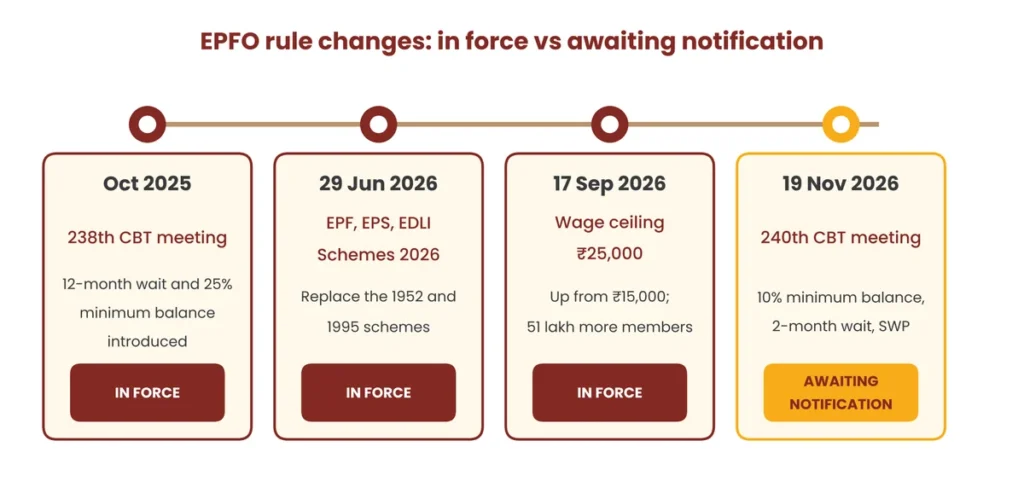
EPFO new rules 2026 fall into two groups. Already in force: the EPF Scheme 2026 and a ₹25,000 wage ceiling. Approved on 19 November 2026 but not yet notified: a 10% minimum balance, a two-month wait for final PF withdrawal and a systematic withdrawal plan. Until the notification, today’s rules apply to your claim.If you opened your phone on 20 November and saw headlines saying you can now withdraw 90% of your PF, you are not alone. The EPFO board did approve that change, but approval is not the same as a rule you can claim under. The scheme has to be amended and notified first, and no effective date has been given yet.That gap between “approved” and “applicable” is where most PF mistakes happen. This guide separates what is already law from what is still on the way, explains the wage ceiling and pension changes in plain rupees, and shows how to withdraw PF online without a rejection. It also covers what to think about before you take money out of your retirement base.Everything here reflects what was public as of 20 November 2026. We will update this page when the Ministry notifies the changes.
Key Takeaways
In force today: The EPF, EPS and EDLI Schemes, 2026, from 29 June 2026, and the ₹25,000 wage ceiling, from 17 September 2026. Contribution rates stay at 12% each for you and your employer.
Approved on 19 November, not yet notified: Minimum PF balance cut from 25% to 10%, a two-month wait for final PF settlement and a systematic withdrawal plan. No effective date has been announced.
Pension: The minimum EPS pension stays at ₹1,000 a month. A hike to ₹3,000 was discussed in the media before the meeting, but no pension increase was part of the decisions reviewed.
Final pension withdrawal: The wait stays at 36 months. The two-month wait applies only to the PF (EPF) corpus.
What to do now: Do not plan a withdrawal around unnotified rules. Check that your UAN, Aadhaar, PAN, bank account and date of exit are correct, and transfer PF when you change jobs instead of withdrawing.
What Are the EPFO New Rules for 2026 and Which Are in Force?
There are two layers of change, and news headlines often mix them. The first layer is already law: a new legal framework for PF, pension and insurance, plus a higher wage ceiling. The second layer was approved by the EPFO’s Central Board of Trustees (CBT) at its 240th meeting on 19 November 2026 and is waiting for formal amendment.
Which EPFO Rules Apply to You Today, 20 November 2026?
The table below shows each change, what it means and where it stands. Where sources disagree, we have used the official notification dates or the most careful report.
Change
What it means
Status
EPF, EPS and EDLI Schemes, 2026
Replace the 1952 EPF Scheme and the 1995 pension scheme. Contribution rates stay at 12% each for employee and employer.
In force. Notified on 29 June 2026
Wage ceiling of ₹25,000
Mandatory coverage ceiling rises from ₹15,000. First revision since 2014.
In force from 17 September 2026
Three withdrawal categories
The old 13 withdrawal provisions are merged into essential needs, housing needs and special circumstances.
In force under the EPF Scheme 2026
25% minimum balance and 12-month wait for final settlement
The current rules for partial and final withdrawals, introduced in the October 2025 reforms.
In force today, but both are approved for change
20-day claim settlement
Complete claims must be settled within 20 days of receipt, with stricter employer timelines.
In force
Form 121 for TDS exemption
Replaces Forms 15G and 15H for PF withdrawals.
In force from 1 April 2026
10% minimum balance
Members could withdraw up to 90% of the eligible balance.
Approved on 19 November. Awaiting notification
Two-month wait for final PF settlement
Replaces the 12-month wait. EPS pension withdrawal stays at 36 months.
Approved on 19 November. Awaiting notification
Systematic withdrawal plan (SWP)
Retirees can draw PF in monthly, quarterly or half-yearly instalments.
Approved on 19 November. Awaiting notification
Direct voluntary contributions, EDLI relief and AIF investing
Smaller board decisions covered below.
Approved. Amendments or Ministry approval to follow
The practical rule is simple: If a change says “approved” and “awaiting notification”, your claim today will still be processed under the existing rule.
What Did the EPFO Board Decide on 19 November 2026?
The CBT, chaired by Labour Minister Mansukh Mandaviya, took seven decisions. Three of them matter to most members: a systematic withdrawal plan, a lower minimum balance and a shorter wait for final PF settlement. The Indian Express reports that the board reversed parts of its own October 2025 decisions.
How Will the EPFO Systematic Withdrawal Plan Work?
Today, a retiring member typically takes the whole PF corpus as one lump sum. Under the approved plan, retiring members could instead draw it in monthly, quarterly or half-yearly instalments while the rest stays invested. It is voluntary, and reports say it may extend to eligible family members or beneficiaries.
Upstox reports that about 6.32 lakh members aged above 55 with balances above ₹5 lakh are expected to be the first to benefit. If a member dies during the payouts, the nominee or dependent can withdraw the balance or keep receiving instalments. The reports reviewed do not give the instalment formula or a start date.
What Does a 10% Minimum PF Balance Mean in Rupees?
The minimum balance is the share of your PF that must stay in the account when you make a partial withdrawal. Cutting it from 25% to 10% raises the ceiling on what you can take out. The example below uses a ₹10 lakh balance and assumes the whole amount is eligible. The notified rule will define the exact base, so treat the numbers as illustrative.
Rule
Must stay in PF
Can withdraw, up to
Current rule: 25% minimum balance
₹2,50,000
₹7,50,000
Approved rule: 10% minimum balance
₹1,00,000
₹9,00,000
Being able to withdraw more is not the same as it being wise. The retirement cost of early withdrawal is covered in the last section.
What Else Did the Board Approve Besides PF Withdrawal?
Direct voluntary and micro-contributions: UAN-linked ways to add to PF outside employer payroll, such as customer tips. The EPF scheme will be amended after Ministry approval, and an Income Tax Act change is being taken up with the Finance Ministry.
EDLI exemption relief: A six-month window for establishments to renew expired exemptions under the 1976 scheme, with possible relief from contributions, interest and penal damages for a verified transitional period.
Investment in AIFs: In-principle approval to invest up to 3% of fresh accretion in eligible Alternative Investment Funds, within the existing overall investment limit and initially through government-backed entities.
Exemption surrenders: Proposals from 27 establishments to surrender exemptions and four to cancel them, moving about ₹5,996 crore covering 1,44,437 members to direct EPFO administration.
CITES 2.0 update: Auto-processed claims reportedly rose from 39% to 71%, and average settlement time fell from 11.15 to 2.57 days. This is a progress report, not a new rule.
None of these seven decisions, as reported, raised the pension. The pension position is covered below.
How Did the EPF Wage Ceiling Rise to ₹25,000 and Who Gains?
What Does the ₹25,000 Wage Ceiling Change for You?
The wage ceiling decides who must be covered by EPFO and the wage base on which compulsory contributions are worked out. The Union Cabinet raised it from ₹15,000 to ₹25,000 a month, effective 17 September 2026. It is the first revision since September 2014, and the government expects more than 51 lakh additional employees to come under mandatory coverage.
Employees earning between ₹15,000 and ₹25,000 now get PF savings, EPS pension eligibility and EDLI insurance cover. Under the EPF Scheme 2026, those earning above the ceiling are “excluded employees”, and contributions on wages above it are voluntary.
Will Your Take-Home Pay and Pension Change?
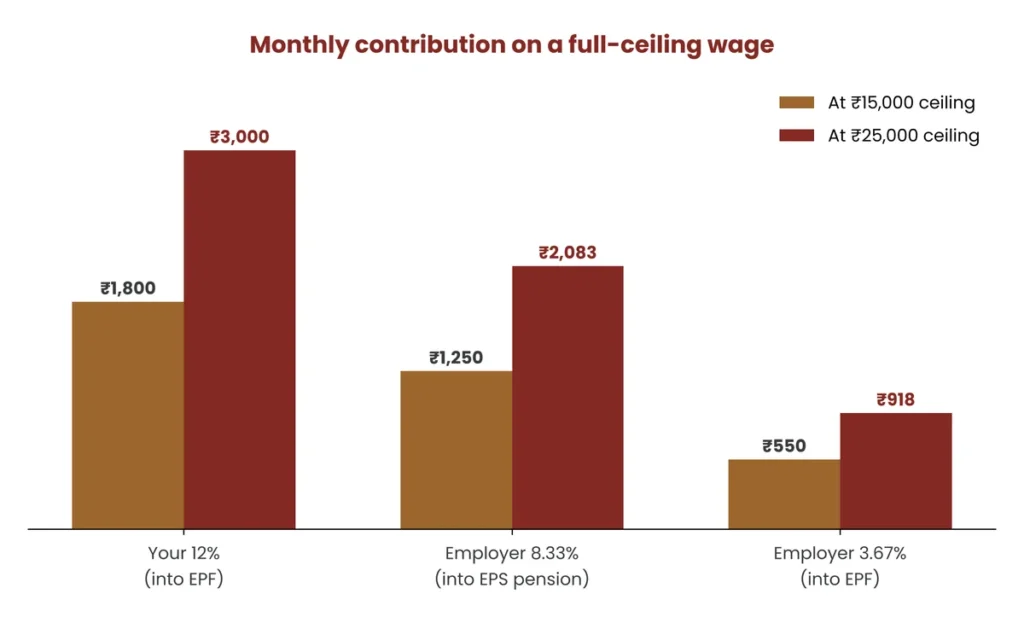
It depends on how your employer calculates PF. If your PF was worked out on the old ₹15,000 cap, the mandatory deduction can rise. The table shows the arithmetic at the full ceiling, using the standard 12% employee share and the 8.33% and 3.67% splits of the employer share.
Monthly amount
At ₹15,000 ceiling
At ₹25,000 ceiling
Your 12% contribution, into EPF
₹1,800
₹3,000
Employer 8.33%, into EPS pension
₹1,250
About ₹2,083, if the pension base moves with the ceiling
Employer 3.67%, into EPF
About ₹550
About ₹918
If your employer already calculated PF on your full basic pay, little changes. If it used the ₹15,000 cap, your take-home can fall a little while your retirement savings rise. Ask your HR or payroll team which applies to you, because the exact treatment of the pension base is for them to confirm. Employer guidance from Fox Mandal covers the compliance side.
What Changed in PF Withdrawal and EPS Pension Rules in 2026?
How Do the Three PF Withdrawal Categories Work?
The EPF Scheme 2026 merged the old 13 withdrawal provisions into three: essential needs, housing needs and special circumstances. Full withdrawal is still allowed after retirement at 55, permanent disability, migrating abroad or retrenchment. A final settlement after a spell without a job is also possible, currently after a 12-month wait.
The scheme also sets a 20-day limit for settling complete claims and requires Aadhaar, PAN and an Aadhaar-seeded bank account for digital processing. Some reports say eligible claims are settled in about three working days, but the scheme text itself sets 20 days as the outer limit.
What Changed for the EPS Pension in 2026?
The Employees’ Pension Scheme, 2026 replaced the 1995 scheme. Members with at least 10 years of eligible service can get a pension. Early pension is available from age 50 with a 4% reduction for each year taken early, and a member can defer the pension up to age 60 for a 4% rise for each completed year. These details come from SCC Online’s review of the scheme.
Members who leave before 10 years can take a withdrawal benefit or a Scheme Certificate. If they do not join another covered employer, the withdrawal benefit becomes payable after a 36-month wait. The minimum pension continues at ₹1,000 a month, the level in force since 1 September 2014.
Did the EPFO Approve a Higher Minimum Pension?
Not in the decisions reported so far. Before the meeting, some outlets said the board might discuss raising the minimum from ₹1,000 to ₹3,000, but the Free Press Journal noted that the government had not confirmed any proposal. Treat any pension-hike headline as a report until an official notification says otherwise.
Has the PF Interest Rate Changed in 2026?
No. EPFO retained 8.25% for 2025-26, and the new EPF Scheme did not change the interest rate. The rate for 2026-27 has not been announced yet. For how monthly interest works and the 10-year rate history, see our guide to the current PF interest rate.
How to Withdraw PF Online and What Documents Do You Need?
Which PF Claim Form Should You Use for Your Case?
Choosing the wrong form is a common reason for rejection. Pick the form that matches your situation.
Form
Use it for
Form 31
Partial withdrawal or advance for eligible purposes while you are still employed
Form 19
Final settlement of your EPF balance after leaving employment
Form 10C
EPS withdrawal benefit or Scheme Certificate, if you are eligible
Form 10D
Monthly pension under EPS
What Are the Steps to Withdraw PF Online?
Log in to the EPFO Unified Member Portal with your UAN, password and CAPTCHA.
Go to Manage, then KYC, and check that Aadhaar, PAN and bank details are linked and verified.
Open View, then Service History, and confirm your date of exit is updated if you are filing for final settlement.
Go to Online Services and select Claim (Form-31, 19, 10C and 10D).
Enter the bank account number linked to your UAN, click Verify and accept the certificate of undertaking.
Click Proceed for Online Claim, choose the form under “I want to apply for”, and enter the reason, amount and address.
Tick the declaration, get the Aadhaar OTP on your linked mobile number and submit.
These steps follow the portal flow described by Jagran Josh and ClearTax. Menu names can change, so follow the labels on screen.
What Documents and KYC Details Should Be Ready?
An active UAN with a password you can log in with.
Aadhaar linked to your UAN, and an Aadhaar-linked mobile number that can receive the OTP.
PAN linked to your UAN. A missing PAN can mean a higher TDS rate.
A bank account linked to your UAN, with the IFSC code matching.
Date of exit updated by your previous employer, if you are filing Form 19 or Form 10C.
Supporting documents only if the portal asks for them. Most online claims do not need uploads.
How Is Your PF Withdrawal Taxed in 2026?
EPF withdrawals are generally tax-free after five years of continuous eligible service. Withdrawals before five years may attract tax and TDS depending on the amount and conditions. Since 1 April 2026, Form 121 replaces Forms 15G and 15H for claiming TDS exemption, subject to conditions.
If you changed jobs, transferring your PF to the new employer with Form 13 keeps your service continuous. That helps with the five-year rule and avoids breaking your retirement compounding.
Should You Withdraw PF Early? What to Check Before You Claim
What Does Early PF Withdrawal Cost Your Retirement?
EPF is the stable core of most salaried people’s retirement plan, and a lower minimum balance makes it easier to dip into it. The cost is easy to underestimate because it compounds. Suppose you withdraw ₹5 lakh at age 35. At a constant 8.25%, which is the rate for 2025-26 and not a promise for the future, that money would have grown to roughly ₹36 lakh by age 60.
That is an illustration, not a forecast. Rates change every year, and the exact figure depends on your contributions. The point is that a withdrawal today removes decades of growth, so it deserves a deliberate decision.
What Should You Do Before the Rules Are Notified?
Do not time a claim around approvals. Wait for the notification and the effective date before assuming you can withdraw 90% or file after two months.
Keep your PF on a job change. Transfer it with Form 13 instead of cashing out.
Fix your records now. Check UAN, Aadhaar, PAN, bank account and date of exit so a claim is not rejected later.
If you are near retirement, watch the SWP rules. Staggered withdrawals may suit your income needs better than a lump sum, but wait for the final design.
EPF is one part of a plan, not the whole plan. If you want help working out how much of it to keep, move or draw down, our financial planning services team can map it against your goals.
Conclusion
The EPFO new rules 2026 are really two stories. One is settled: a new legal framework and a ₹25,000 wage ceiling are already in force. The other is a set of board approvals, including a 10% minimum balance, a two-month wait and a systematic withdrawal plan, that will matter only once they are notified. Until then, keep your KYC clean, transfer PF when you change jobs, and treat any withdrawal as a decision about your retirement, not just your cash flow.
FAQ
The EPFO new rules 2026 include the EPF, EPS and EDLI Schemes, 2026, in force since 29 June 2026, and a wage ceiling raised to ₹25,000 from 17 September 2026. On 19 November 2026 the EPFO board also approved a 10% minimum balance, a two-month wait for final PF settlement and a systematic withdrawal plan. These three are not yet notified, so existing rules apply for now.
Under the current rule, final PF settlement after unemployment needs a 12-month wait. The board has approved reducing this to two months, but it is awaiting notification. The two-month wait applies only to the EPF corpus. Final pension (EPS) withdrawal stays at 36 months. If you are changing jobs, transferring your PF with Form 13 is usually better than withdrawing it.
It is a voluntary option approved on 19 November 2026 that lets retiring members draw their PF in monthly, quarterly or half-yearly instalments instead of one lump sum, while the rest of the balance stays invested. Reports say it may extend to eligible family members or beneficiaries. The detailed rules and start date have not been published, so it is not available to claim yet.
The wage ceiling for mandatory EPFO coverage has risen from ₹15,000 to ₹25,000 a month, effective 17 September 2026. It is the first revision since 2014 and is expected to bring over 51 lakh more employees under cover. At 12%, the mandatory employee contribution on a full ₹25,000 wage is ₹3,000 a month. Ask your employer how PF is calculated on your salary.
No. The rate for 2025-26 is 8.25%, and the EPF Scheme 2026 did not change the interest rate. The rate for 2026-27 has not been announced yet. EPF interest is worked out monthly on your running balance and credited once a year. For the history and the calculation method, see Right Horizons' guide to the current PF interest rate.
At Right Horizons, your safety and security are important to us. To protect your interests, we urge you to only reach out to us through the verified contact accounts listed on our official website www.righthorizons.com.
Please be vigilant and avoid responding to unsolicited emails, messages, or phone calls claiming to be from Right Horizons. We will never request sensitive information such as passwords, account details, or financial information via unsecured channels.
Furthermore, please note that we do not distribute investment and advisory audio and video clips through unsolicited means. Any communication regarding such content will always be done through secure and verified channels.


 Talk to us