
EPF interest rate for FY 2025-26 is 8.25%, credited annually on 31 March. Contributions from both employee and employer are tax-free up to ₹2.5 lakh a year, and monthly compounding on your running balance makes EPF the low-risk, tax-efficient core of a long-term retirement plan.
If you’ve checked your payslip lately, you already know a chunk of your basic pay disappears into your PF account every month without you doing anything. What most people don’t check as often is what that money is actually earning. The current PF interest rate stands at 8.25% for FY 2025-26, the third year in a row at this level. That one number decides how fast a mandatory deduction turns into a real retirement corpus, so it’s worth actually understanding instead of just glancing past it in your passbook.
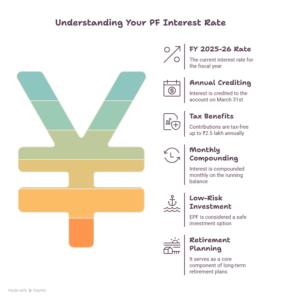
Here’s what the rate means, how the interest is worked out month by month, how it’s moved over the last decade, and where it sits next to your other savings.
The rate on your EPF account is reviewed once a year, and for FY 2025-26 it was set at 8.25%, with the credit process rolling out to over seven crore accounts through the year.
A few things make this rate different from what you’d get on a savings account or FD. It’s tax-free on contributions and interest up to the prescribed limit, it applies the same way to every EPF account in the country, and it has nothing to do with how your specific employer’s business is doing. It’s one government-set number, and every member gets it, whether they work at a startup or a large corporation.
Here’s the part that trips most people up: EPF interest is calculated every month, but it doesn’t land in your account every month. Under the governing rules for the scheme, it works like this:
Quick example: say your EPF balance was ₹5,00,000 at the start of the year and stayed roughly steady. That works out to about ₹41,250 in interest at 8.25%, credited on 31 March. That amount then joins your balance, so next year’s interest is calculated on a slightly bigger number. That’s the compounding effect doing its job.
Rates move each year depending on how the fund’s investments perform. Here’s the full year-wise record:
| Financial Year | Interest Rate |
|---|---|
| 2015-16 | 8.80% |
| 2016-17 | 8.65% |
| 2017-18 | 8.55% |
| 2018-19 | 8.65% |
| 2019-20 | 8.50% |
| 2020-21 | 8.50% |
| 2021-22 | 8.10% |
| 2022-23 | 8.15% |
| 2023-24 | 8.25% |
| 2024-25 | 8.25% |
| 2025-26 | 8.25% |
Rates grouped by band (quick scan):
| Rate Band | Financial Years |
|---|---|
| 8.80% (decade high) | 2015-16 |
| 8.65% | 2016-17, 2018-19 |
| 8.55% | 2017-18 |
| 8.50% | 2019-20, 2020-21 |
| 8.25% (current) | 2023-24, 2024-25, 2025-26 |
| 8.15% | 2022-23 |
| 8.10% (decade low) | 2021-22 |
A couple of things jump out. The rate hasn’t dropped below 8% in any of these years, and hasn’t gone below 8% since 1977-78. The lowest point in the last decade was 8.10% in 2021-22, and it’s held steady at 8.25% for three years since. Even a small dip matters at scale: on a ₹10 lakh balance, the gap between 8.80% and 8.10% is around ₹7,000 in a single year.
Interest only compounds if money is actually going in every month, so here’s how that split works, as laid out by the scheme rules:
In practice, your visible EPF balance grows by 15.67% of your basic pay each month (12% from you and 3.67% from your employer). The other 8.33% builds your future pension separately and won’t show up in your EPF passbook, so don’t panic if the numbers don’t seem to add up.
Say your basic salary plus DA is ₹25,000 a month.
At 8.25%, that monthly inflow, left untouched and compounded annually, adds up meaningfully over a 20- to 30-year career, since each year’s interest becomes part of the base for the next.
Before treating EPF as your default retirement pot, it helps to see how it compares with the other two most common fixed-income options Indian savers use.
| Feature | EPF | PPF | Bank FD |
|---|---|---|---|
| Current interest rate | 8.25% (FY 2025-26) | 7.1% (Jul–Sep 2026) | 6.5%–7.5% (varies by bank/tenure) |
| Who can open | Salaried employees only | Any Indian resident | Anyone |
| Employer match | Yes (3.67% to EPF) | No | No |
| Lock-in | Till retirement / job change | 15 years | 7 days to 10 years (chosen) |
| Tax on interest | Tax-free up to ₹2.5 lakh/yr contribution | Fully tax-free | Fully taxable at slab rate |
| Section 80C benefit | Yes | Yes | Only tax-saver FDs (5-yr) |
| Risk | Government-backed | Government-backed | Bank-backed (DICGC up to ₹5 lakh) |
| Best used for | Core retirement corpus | Long-term tax-free savings | Short-to-medium-term parking |
The pattern is clear: EPF offers the highest headline rate and an employer match, PPF gives you a fully tax-free option available to everyone, and FDs work best when you actually need the money back sooner.
EPF isn’t the only place to park long-term savings, but a few things make it a sensible starting point for the rest of your portfolio.
It’s mandatory, so it happens without you thinking about it. Once you’re formally employed, contributions go in automatically every month, which removes the discipline problem that trips up most voluntary savings plans.
The returns are tax-free within limits. EPF falls under the Exempt-Exempt-Exempt structure: contributions up to ₹1.5 lakh per year qualify for deduction under Section 80C, interest is tax-free up to the prescribed threshold, and withdrawals after five years of continuous service are also tax-free. Interest on contributions above ₹2.5 lakh in a year does get taxed, but that mainly affects high earners or people making large voluntary contributions.
That’s why a lot of people treat EPF as the low-risk, tax-efficient base of their retirement plan, and build market-linked instruments like mutual funds, NPS, or direct equity around it for the growth a fixed-income product can’t provide. EPF gives you predictability and a floor; the rest of your portfolio can chase higher returns at higher risk.
One thing people rarely ask about: what happens to your interest once you stop working. EPF interest doesn’t only apply while you’re actively contributing. If your account goes quiet because you’ve left a job, moved abroad, or retired, interest continues to accrue for up to 3 years from the date contributions stopped. After 36 months with no activity, the account is marked dormant and stops earning interest, though your balance stays safe and you can still withdraw it.
So even after you retire, there’s a window where your balance keeps growing before you need to move or withdraw it, which is worth factoring into your timing.
The current PF interest rate of 8.25% has held steady for three years running, sitting comfortably within the 8% to 8.8% range the scheme has occupied over the last decade, and it hasn’t dropped below 8% in almost five decades. Add in mandatory monthly contributions, an employer match, and tax-free compounding under Section 80C, and EPF remains one of the more dependable pieces of a retirement plan. Once you understand how contribution splits work and how interest is calculated month to month, it’s a lot easier to treat EPF as the stable core of your investment mix, rather than just a line item on your payslip.
 Talk to us
Investor Grievance
Talk to us
Investor Grievance


