Skip to main
Menu Open Menu Close
Close Menu
🔔 Exciting Update
RH Rising India Opportunities AIF is Now Live! Know More       RH Rising India Opportunities AIF is Now Live! Know More       RH Rising India Opportunities AIF is Now Live! Know More       RH Rising India Opportunities AIF is Now Live! Know More       RRH Rising India Opportunities AIF is Now Live! Know More       RH Rising India Opportunities AIF is Now Live! Know More      

How Indian Couples Should Plan Retirement Together: His Plan, Her Plan, One Goal


Introduction

Retirement isn’t something that happens to you; it’s something you build together. For Indian couples, the stakes are particularly high. Unlike single earners, dual-income households face a unique puzzle: two careers, two financial histories, two risk appetites, and yet a single shared future.

The complexity isn’t just mathematical. It’s personal. She may have taken career breaks. He might have lost income during transitions. One partner might be more conservative; the other, aggressive. These differences are real. The good news? They’re not obstacles. They’re the foundation of a stronger retirement plan.

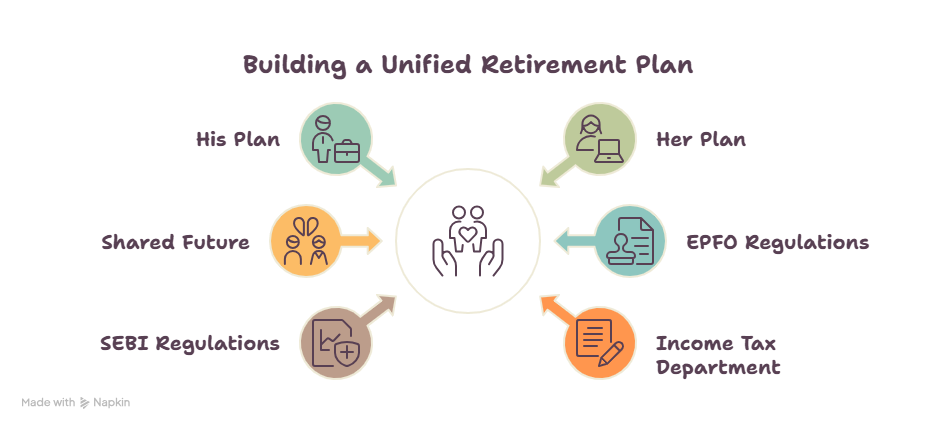
This guide walks you through a practical approach to retirement planning for married couples in India, one that honors both perspectives while moving toward one unified goal, based on regulations from the Employees’ Provident Fund Organization (EPFO), Securities and Exchange Board of India (SEBI), and the Income Tax Department.
What Makes Retirement Planning for Couples Different?

Single individuals plan for themselves. Couples plan for themselves, their spouse, and the shared life they want to build. This distinction matters profoundly.

Key Differences in Couple-Specific Retirement Planning:

  • Dual income complexities: Varying salaries, different contribution capacities, and unequal retirement corpus.
  • Income dependency: Reliance on one or both incomes; contingency planning if one partner stops earning.
  • Individual tax planning: Separate tax filings and optimization strategies based on individual income brackets.
  • Behavioral misalignment: Different risk tolerances and spending philosophies require compromise.
  • Longevity risk: Extended life expectancy means planning for potentially 30+ years of joint retirement.

There is no standard retirement corpus for every Indian couple. The right amount depends on lifestyle, city, healthcare needs, inflation, liabilities, and expected retirement age.

Step 1: Have the Money Conversation (Actually Have It)

Most couples avoid discussing money. This is the first mistake.

Before building a retirement plan, you need clarity on five things:

1. Income Reality

Write down the current take-home income for each partner. Not gross salary — actual money hitting your accounts after taxes. This number is your foundation.

2. Existing Assets

List what you already own: home value, cars, savings accounts, investments, life insurance policies, and provident fund balances. Couples often have fragmented assets that haven’t been consolidated.

3. Debt Picture

Home loans, personal loans, and credit card debt all affect retirement readiness. A couple with ₹50 lakhs in savings but ₹30 lakhs in outstanding debt is in a weaker position than a couple with ₹35 lakhs in savings and no debt.

4. Expected Lifestyle

What does retirement mean to you both? Will you travel monthly? Maintain current spending? Reduce expenses? This shapes your target corpus.

5. Risk Tolerance

One partner’s answer to “Can you handle a 20% market drop?” might differ significantly from the other’s. Document these honestly.

This conversation is essential. When both partners understand the complete financial picture, they can make informed decisions about joint retirement planning.

Step 2: Calculate Your Joint Retirement Corpus

The corpus calculation uses a simple formula, but the inputs require careful attention to detail.

Formula for Retirement Planning for Dual-Income Couples:

Retirement Corpus = Annual Expense × Years of Retirement × Inflation Factor

Here’s how it works in practice:

Example Scenario:

  • Combined annual household spending: ₹12 lakhs
  • Inflation rate: 6% annually (historical average)
  • Years to retirement: 15 years
  • Years in retirement: 25 years (age 60 to 85)

Using the inflation-adjusted calculation:

  1. Future annual expense (after 15 years of 6% inflation): ₹12 lakhs × (1.06)^15 = ₹28.7 lakhs
  2. Present value of 25 years of expenses: ₹28.7 lakhs × 13.5 (PV annuity factor at 6% return) = ₹3.87 crore

This is your target corpus. For a couple expecting to live to 85 at current spending levels and 6% annual inflation, the goal is ₹3.87 crore.

Key point: This isn’t one partner’s responsibility. It’s a joint target requiring both salaries.

Step 3: Separate Plans That Work Together

This is where “His Plan” and “Her Plan” become one retirement strategy.

Understanding Contributions by Income Level

In most Indian dual-income households, contributions are unequal. Partner A might earn ₹1.2 crore annually; Partner B, ₹70 lakhs. This doesn’t mean Partner B should contribute less to retirement. Here’s why:

Contribution Strategy:

  • Higher earner: Maximize tax-advantaged accounts (NPS, EPF) + invest surplus in mutual funds.
  • Lower earner: Prioritize building an independent retirement corpus to reduce spousal dependency in later years.

Why independent accounts matter: If one partner becomes unable to work due to health or other reasons, the other isn’t suddenly carrying the entire retirement burden.

Allocation Across Account Types

EPF/PPF Allocations:

  • Both partners should maximize EPF contributions (up to ₹2.5 lakhs annually for employees).
  • If either partner is self-employed or freelance, open separate PPF accounts (₹1.5 lakhs annually).

National Pension System (NPS):

Voluntary Investments:

  • Equity mutual funds: ₹5–10 lakhs annually per person (depending on risk appetite).
  • Debt funds or fixed deposits: ₹2–3 lakhs annually (for stability).

Insurance and Risk:

  • Both partners need adequate term life insurance (₹50 lakhs minimum each).
  • Consider long-term care insurance to protect retirement savings.

Step 4: Understand Your Tax Position

In India, each person files an individual tax return. Unlike in some countries, there is no joint married tax-filing system. Instead, each partner optimizes their personal tax situation within the Income Tax Act framework.

Individual Tax Planning Strategies for Married Couples:

1. Section 80C Benefits (₹1.5 lakh annual deduction)

Each partner can independently claim:

  • EPF contributions up to ₹1.5 lakhs
  • PPF contributions up to ₹1.5 lakhs
  • ELSS (Equity Linked Savings Schemes) investments
  • Life insurance premiums

2. Section 80CCD(1B) — NPS Benefit

Additional ₹50,000 deduction beyond the ₹1.5 lakh 80C limit for NPS Tier I contributions. Both partners can claim this separately.

3. Section 80D — Health Insurance Deduction

Health insurance premiums:

  • ₹25,000 per individual (for self and dependents)
  • ₹50,000 per individual (for self/spouse if 60+ years, or parents)

Each partner can claim independently based on their own health insurance policies.

4. Income from House Property

If the couple owns multiple properties, consider who should claim what to minimize the family’s tax burden. However, each person files individually; there’s no joint filing system in India.

5. Staggered Withdrawals in Retirement

Both partners can time their EPF and NPS withdrawals, as well as other pension income, across different financial years to optimize taxable income each year and minimize tax liability together.

Step 5: Plan for Contingencies

The hardest part of couple-based retirement planning is acknowledging that one partner might not make it to retirement together.

Contingency Planning:

  • Life insurance: Both partners need adequate coverage. EPF and NPS policies have nominee provisions. Additionally, term insurance ensures the surviving spouse can maintain a retirement corpus if one partner passes away.
  • Disability planning: If either partner becomes unable to work due to illness, can the household absorb the loss? Disability insurance should be considered.
  • Survivor benefits: Ensure all pension accounts and insurance products are structured to benefit the surviving spouse through proper nominee registration.

Key Takeaways

  1. Retirement planning for married couples differs fundamentally from individual planning; it requires alignment and shared accountability.
  2. Your target retirement corpus depends on three variables: current spending, inflation, and years in retirement.
  3. Both partners should contribute to retirement independently while coordinating toward a joint goal.
  4. Each partner files taxes individually in India — optimize deductions under Sections 80C, 80CCD(1B), and 80D separately.
  5. Start early. The longer your investment horizon, the more compound growth benefits both partners.

Conclusion: Making Retirement Planning Work for Your Relationship

Retirement planning for couples is fundamentally different from planning as an individual. It requires honest conversations, aligned goals, and ongoing coordination. The framework outlined here — from the initial money conversation through contingency planning — works because it addresses both the financial and relational dimensions of shared retirement.

The couples who succeed at retirement planning typically follow a predictable pattern: they talk openly about money, establish a shared target, contribute according to their capacity, and review progress annually. They don’t need perfect alignment on every decision; they need sufficient alignment on the destination.

Whether you implement this framework immediately or gradually, the key is to begin the conversation. Many couples delay retirement planning because they’re overwhelmed by complexity. In reality, the complexity emerges only when you start addressing it. The earlier you begin, the more time compound growth works in your favor, and the more flexibility you have to adjust course if circumstances change.

The financial mechanics are straightforward. The relational aspect — ensuring both partners feel heard, involved, and secure in the plan — is what actually makes retirement planning sustainable over 15, 20, or 30 years of shared life.

Your retirement won’t be built by one person’s salary or decision-making. It will be built through both partners’ contributions, intentionality, and regular reassessment. That’s what makes it resilient.

FAQ

Keep them separate but coordinated. According to EPFO guidelines, each member must maintain an individual account. Separate accounts provide flexibility, independent security, and clearer tracking. Coordination ensures you're both moving toward the same corpus goal.
This is common in India. Address it by having the higher earner contribute proportionally more to NPS and mutual funds, while the lower earner focuses on building independent retirement savings. Under Section 80C, each partner can independently claim deductions, so both have equal tax-planning opportunities regardless of income level.
Divide the portfolio. One partner manages 40% of joint investments in equity/growth assets (in line with their risk appetite). The other manages 40% in stable assets like PPF and fixed deposits. The remaining 20% is jointly decided. This respects both perspectives.
Both. According to EPFO and PFRDA guidelines, EPF provides forced savings with employer contributions (8.25% interest, FY 2025-26). NPS offers market-linked growth and tax efficiency (Tier I contributions get a deduction under Section 80CCD). PPF provides guaranteed returns and tax-free interest. Use both, max out EPF first (mandatory for salaried employees), then supplement with NPS and PPF. This creates a dual-layer retirement structure aligned with government retirement schemes.
Now. A SEBI-registered investment advisor (RIA) can help structure your plan in accordance with regulations, optimize tax strategies under the Income Tax Act, and review your progress annually. For couples, this typically costs ₹15,000–₹50,000 per year (within SEBI's ₹1.25 lakh annual cap for RIAs).
Plan for it upfront. If one partner wants to stop working at 55, calculate what that means for household income. According to EPFO rules, NPS allows early withdrawal for specific purposes. Early retirement for one is feasible if the other continues earning until 62–65.
talk to usTalk to us testing Investor Grievance