



A family office in India is a private team that manages a wealthy family’s investments, tax, legal affairs and succession as one coordinated plan. It can serve one family or several. This guide explains the types, services, costs, rules and set-up steps for HNIs and UHNIs.
Most wealthy Indian families do not begin with a plan for managing wealth. They begin with a business, a stake sale, an ESOP payout or an inheritance, and then add a chartered accountant, a lawyer, two or three wealth managers and a few bank relationship managers over the years. Each of them sees one piece. Nobody sees the whole picture.
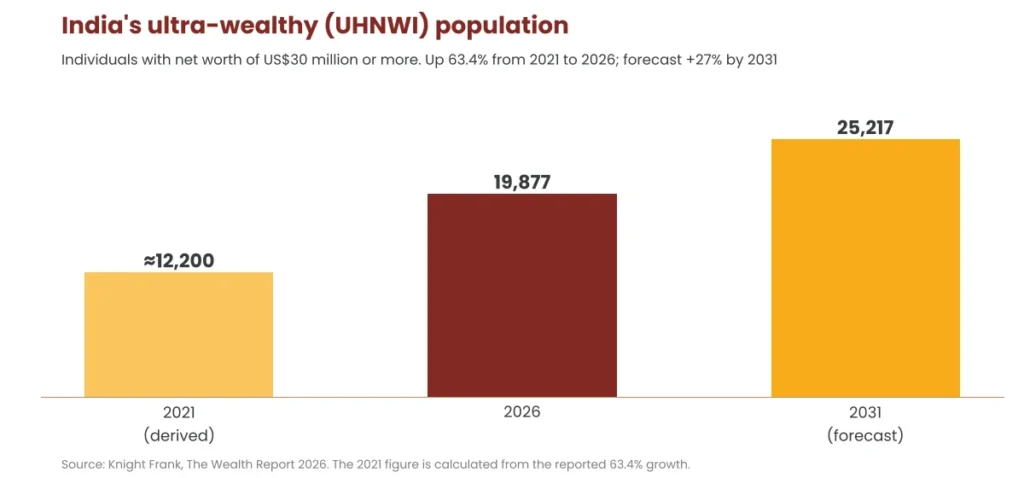
A family office exists to close that gap, and the need is growing. Knight Frank’s Wealth Report 2026 counts 19,877 ultra-high-net-worth individuals in India, up 63.4% in five years. If you are an HNI or UHNI, the questions are practical. What is a family office, which type fits, what does it cost, which rules apply and when does it make sense? We answer each of them below in plain language.
A family office is a private set-up that manages a wealthy family’s money and the decisions around it. Think of it as the family’s own finance, tax and legal desk, working to one set of goals instead of five. It looks after investments, tax, estate and succession, consolidated reporting and, often, non-financial matters such as philanthropy and preparing the next generation. India has no separate law or licence for family offices, and there is no universally accepted definition of an ultra HNI or a family office, which is why two firms can use the same label for very different services.
A private banker or wealth manager usually sells you products or advice in one area. A family office works for the family and coordinates every adviser, product provider and legal entity on its behalf. The difference shows up in who is accountable for the whole picture. If your CA, your lawyer and your portfolio manager never speak to each other, you are the family office, and that is rarely the best use of your time.
Indian families can choose from four structures. The wealth ranges below are the figures commonly quoted by practitioners. They are not set by any regulator, and different sources quote different numbers.
| Type | Who it serves | Commonly cited wealth range | Main strength | Main limitation |
|---|---|---|---|---|
| Single family office (SFO) | One family | About ₹100 crore to ₹500 crore or more | Full control, privacy and a team built around your family | High fixed cost: roughly ₹1 crore to ₹5 crore a year |
| Multi family office (MFO) | Several unrelated families | About ₹25 crore to ₹300 crore | Shared team and technology at a lower cost | Less customisation, shared attention |
| Virtual family office (VFO) | One family, with outsourced experts | About ₹20 crore to ₹100 crore | Flexible, no large in-house team | Coordination depends on one lead adviser |
| Family investment fund (FIF), GIFT City | One family, through an IFSCA-regulated fund | Minimum corpus of US$10 million within three years | Global investing under India-based oversight | Cross-border rules, set-up and tax need expert advice |
Sources for these ranges: Treelife, Dealplexus and Equirus Wealth. They differ because there is no official threshold.
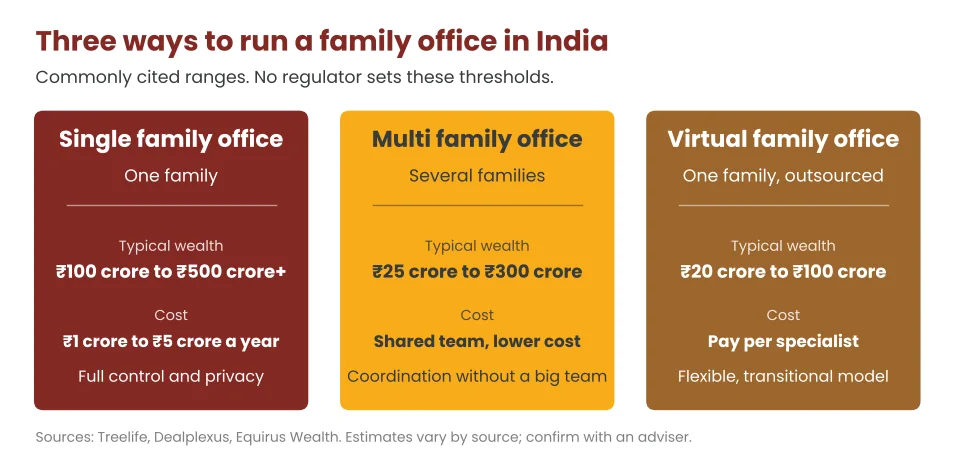
For most families we speak to, the real choice is between a multi family office and a single family office. A single family office makes sense only when the assets, the number of entities and the family’s complexity justify a full-time team. Until then, a multi family office can offer much of the same coordination at a fraction of the cost.
Global reports define an ultra-high-net-worth individual (UHNWI) as someone with a net worth of US$30 million or more, which is roughly ₹282 crore at the exchange rate Knight Frank used. Indian wealth firms often work with a lower line. Many treat about ₹25 crore of investable assets as the point where needs move from high net worth to ultra high net worth, and some multi family offices start at ₹25 crore. The label matters less than the complexity of your wealth.
Quickly. Knight Frank’s Wealth Report 2026 puts India’s UHNWI count at 19,877, which makes it the sixth largest market in the world. It expects the number to reach 25,217 by 2031. India also has 207 billionaires, the third highest in the world. Mumbai holds 35.4% of the country’s ultra-rich, though wealth is spreading to more cities.
Take a hypothetical example. A Bengaluru founder sells her company for ₹150 crore. Within a year she has proceeds spread across three banks, a trust her lawyer set up, a property purchase her CA is still structuring and a sibling abroad who needs a share. A family office would bring all of this onto one balance sheet, one investment policy and one calendar of tax and compliance dates. This is an illustration, not a client case.
Honesty matters here. If your investable wealth is below about ₹25 crore, a full family office usually costs more than it saves. Practitioners suggest a portfolio management service, a Category II AIF and an independent adviser for that range. A simple, well-planned portfolio with a good estate plan can serve you better than a structure you cannot fill.
The scope differs from one family office to another. Most cover the six areas below, and the best ones start with the family’s goals before touching a product.
| Service area | What it usually covers |
|---|---|
| Investment management | Asset allocation, manager selection, direct and alternative investments, rebalancing |
| Tax and structuring | Tax-efficient planning, clubbing rules, entity structure, annual filings |
| Estate and succession | Wills, trusts, nomination, business succession and family agreements |
| Cross-border wealth | LRS and ODI planning, NRI family members, overseas assets and reporting |
| Family governance | Family constitution, next-generation education, decision rights, philanthropy |
| Reporting and risk | Consolidated reporting, insurance review, cybersecurity and document vault |
This is the core, and it starts with a written investment policy that records your risk limits, liquidity needs and who can approve what. From there the office builds the allocation across equity, debt, real estate and alternatives. Our guide to asset allocation for high-net-worth investors explains the thinking, and top investment options for HNIs covers the choices. Many UHNI families also use alternative investment funds and startup investments for a part of the portfolio.
A good family office keeps tax in step with investing instead of treating it as a year-end exercise. One trap is clubbing: under Sections 60 to 64 of the Income-tax Act, income from assets you transfer to a spouse or minor child can be added back to your own income. Structures set up only to save tax, without a business reason, can also attract the General Anti-Avoidance Rule (GAAR). Read more in our guide to tax-efficient wealth management for HNIs.
Under the Liberalised Remittance Scheme, an individual can remit up to US$250,000 per financial year. The limit applies to each person, not to the family. Families with overseas children, foreign assets or global ambitions need a plan that keeps FEMA, tax residency and reporting aligned. Our articles on currency risk in international investing, geographic diversification and NRI estate planning go deeper.
Wealth rarely fails because of one bad investment. It fails because the family cannot agree on how to decide. A family office helps draw up a family charter, a succession calendar and a way to bring the next generation into decisions early. Our note on securing your family’s future is a good starting point.
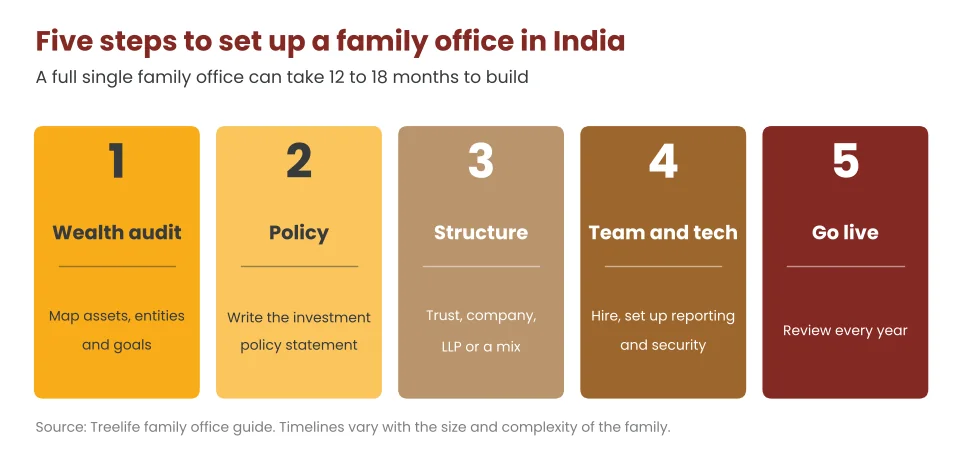
Setting up a family office is a legal, tax and people project. Build in 12 to 18 months for a full single family office, according to Treelife’s guide, and expect to involve a chartered accountant, a lawyer and an investment adviser from the start.
Most families combine structures. A common set-up is a private trust at the top that holds shares in a company or LLP that runs the operations, with governance papers beside the trust deed, as AP&K Partners explain.
| Structure | How it works | What to watch |
|---|---|---|
| Private trust | Good for succession and asset protection; lighter filing load | Taxed at the maximum marginal rate unless beneficiaries are identified |
| Private limited company | Separate legal entity that can hire staff and hold investments | About 25.17% effective tax, plus tax on dividends in shareholders’ hands; regular board and annual filings |
| LLP | Pass-through taxation and flexible partnership terms | Harder to bring in the next generation as equity holders |
These points are general. Your CA should confirm the tax position for your own case, because it depends on who the beneficiaries are and how assets move in.
Yes, depending on what the office does. SEBI said in October 2025 that it is not examining a family office framework. A single family office that manages only its own family’s wealth generally falls outside SEBI’s net. The picture changes when outside money or outside clients are involved:
Costs vary because there is no standard model, and the two guides reviewed quote different ranges.
| Set-up | Estimated annual cost | Source |
|---|---|---|
| Lean single family office, outsourced CIO and compliance | ₹40 lakh to ₹80 lakh | Dealplexus |
| Standard single family office | ₹1 crore to ₹2 crore | Dealplexus |
| Full-service single family office | ₹2 crore to ₹4 crore | Dealplexus |
| Single family office with a 4 to 6 person core team | ₹2.5 crore to ₹5 crore | Treelife |
Staff usually make up the largest share. A multi family office spreads that cost across clients, and fee models vary, so ask for the fee basis in writing. Compare it with what you pay today across all your advisers.
GIFT City offers a regulated route for single families. The International Financial Services Centres Authority (IFSCA) allows a family investment fund that pools money only from a single family under its Fund Management Regulations, 2025. Treelife notes a minimum corpus of US$10 million within three years of registration, and Indian residents put money in through LRS.
The rules for resident families have been evolving: a 2024 report said the industry was still awaiting regulatory clarity, and the first approved fund, reported in April 2026, was for a non-resident family. Please take current advice from a specialist before you decide.
This is a long-term relationship with access to your most sensitive information, so choose carefully. Here is what we would check before you sign anything:
Right Horizons has worked with UHNI clients and family offices for over 22 years, with a team that includes CFAs and CFPs. Our family office services follow a four-step process: understand the landscape, assess and analyse, lay the groundwork and get started, with a roadmap reviewed as your family changes. We are product and asset class agnostic, and we say upfront that we also have an in-house portfolio management arm, so you can weigh that when you compare us.
Families in Bengaluru, Mumbai, Chennai, Gurugram and Kochi ask us the same questions. The structure stays the same everywhere, while tax, property and succession details change from case to case. You can also read about our private wealth management approach, or start with our financial planning services.
A family office in India is less about a fancy structure and more about one clear plan for your family’s wealth. For some families that means a single family office, for many it means a multi family office, and for others a well-run portfolio and a good estate plan is enough. Start with a wealth audit, write down your goals and then pick the structure. If you would like an honest view on where your family stands, speak to the family office team at Right Horizons or begin with a free portfolio scan.
 Talk to us
Investor Grievance