
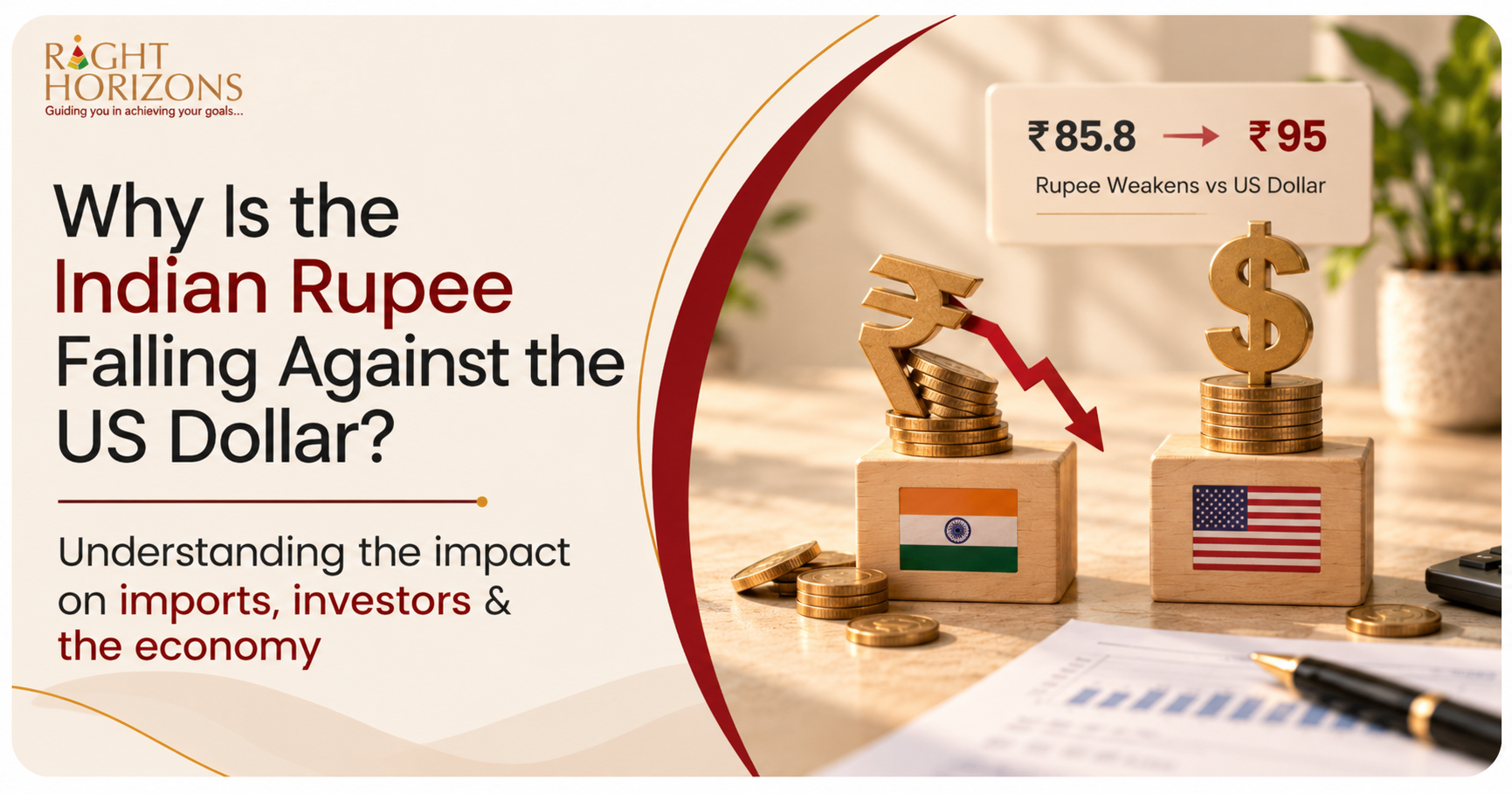
The Indian rupee has depreciated approximately 10% against the US dollar between January 2025 and October 2026. At the beginning of 2025, one US dollar was worth approximately ₹85.80. By mid-October 2026, it was trading around ₹95.
However, this is not a recent phenomenon. Over the years, the rupee has generally followed a weakening trend against the dollar, with occasional periods of appreciation.
But why does this happen? What makes the US dollar stronger while the Indian rupee continues to lose value?
To understand this, we first need to look at how exchange rates work.
Like the price of any other commodity, the value of a currency is largely determined by demand and supply in the foreign exchange market.
When demand for US dollars increases relative to the supply of dollars, the dollar becomes more expensive in rupee terms. Conversely, when more dollars flow into India and their supply increases relative to demand, the rupee can strengthen.
For example, suppose one US dollar is worth ₹85. If demand for dollars increases significantly, the exchange rate might move to ₹90 per dollar. This means an Indian buyer now needs ₹5 more to purchase the same dollar.
This is called rupee depreciation.
Several factors influence this demand and supply, including international trade, foreign investments, interest rates and global economic developments.
India is a major import-dependent country, with imports being more than exports. It imports substantial quantities of gold, electronics, machinery and other essential goods.
Since much of international trade is conducted in US dollars, Indian importers need dollars to pay their overseas suppliers.
Consider an Indian company importing machinery worth $1 million. At an exchange rate of ₹85 per dollar, the company needs ₹8.5 crore. If the rupee value falls to ₹95, the same machinery costs ₹9.5 crore, assuming its dollar price remains unchanged.
The company now needs an additional ₹1 crore to purchase the same machinery.
Foreign investors play an important role in India’s financial markets. They invest in Indian equities, bonds and businesses, bringing foreign currency into the country.
When foreign investors invest in India, they generally convert dollars into rupees, increasing the supply of dollars and supporting the rupee.
However, the opposite happens when they withdraw their investments.
Suppose a foreign investor sells Indian shares worth ₹5 crore and decides to take the money back to the US. The investor must convert the rupees received from selling those shares into dollars.
When many investors do this simultaneously, demand for dollars increases, putting downward pressure on the rupee.
Foreign portfolio investors have continued withdrawing funds from Indian equities in 2026, contributing to the currency’s weakness. Global uncertainties and better investment opportunities in other countries have contributed to this selling pressure.
Interest rates in the United States also influence the value of the dollar.
When the US Federal Reserve raises interest rates or keeps them relatively high, US government bonds can become more attractive to global investors.
For example, an investor may prefer investing in US government bonds offering relatively attractive yields rather than taking additional risks in emerging markets.
If investors shift funds from countries such as India towards the US, the demand for dollars rises, reducing the demand for rupees.
However, interest rates are not the only consideration. Investors also evaluate currency risk, economic growth, investment returns and overall market stability before moving their money.
During periods of global economic uncertainty, investors often prefer holding assets they consider relatively safe and liquid.
The US dollar benefits from this preference because of its widespread use in international trade, financial transactions and global reserves.
Events such as geopolitical conflicts, disruptions to global trade and financial market instability can increase demand for dollars.
For India, rising crude oil prices have created additional pressure. Since India depends heavily on imported oil, higher prices increase the dollar payments required by oil-importing companies.
In 2026, elevated oil prices and geopolitical tensions, particularly in West Asia, have added to the pressure on the rupee.
An important reason behind the dollar’s strength is its dominant position in the global financial system.
The US dollar is the world’s primary reserve currency and is widely used for international trade.
Central banks across the world hold a significant portion of their foreign exchange reserves in dollars. Many globally traded commodities, including crude oil, are also priced in dollars.
This creates demand for the currency beyond transactions directly involving the United States.
For example, when an Indian company purchases oil from an overseas supplier, the transaction may be settled in US dollars even though neither party is American.
However, the dollar is not always strengthening. Its value also fluctuates depending on US economic conditions, monetary policy and global investor sentiment.
A depreciating rupee has both positive and negative effects on the economy.
| Area | Likely Impact |
|---|---|
| Imports | Businesses importing crude oil, electronic components or machinery must spend more rupees for the same dollar-denominated purchases. |
| Foreign Debt | Indian businesses with dollar-denominated loans may need more rupees to repay the same outstanding dollar amount, unless they have sufficient dollar earnings or currency protection. |
| Exporters | Indian IT companies, pharmaceutical manufacturers and other exporters earning revenue in dollars may receive more rupees when converting their foreign earnings. |
Therefore, a weaker rupee does not affect every sector in the same way.
The Reserve Bank of India (RBI) plays an important role in managing excessive volatility in the foreign exchange market.
When the rupee depreciates sharply, the RBI can sell US dollars from its foreign exchange reserves to increase their availability in the market. This can help reduce pressure on the currency.
The RBI has also used measures aimed at encouraging foreign currency inflows through the Foreign Currency Non-Resident (FCNR) deposit scheme, under which NRIs can deposit money in foreign currencies with Indian banks without direct exposure to rupee depreciation on those deposits.
In 2026, the RBI introduced a special dollar–rupee swap facility aimed at encouraging banks to attract these deposits. Such arrangements can support dollar inflows into India and help stabilize the rupee.
However, the central bank cannot permanently control the exchange rate through intervention alone. Currency movements are ultimately influenced by international trade, investment flows and global financial conditions.
The rupee’s depreciation against the US dollar is not caused by a single factor. India’s dependence on imports, foreign investment outflows, US interest rates and global uncertainties all influence its movement.
The dollar’s dominant role in global trade also gives it a structural advantage in international currency markets.
While the RBI can help manage excessive fluctuations, the rupee’s longer-term stability will depend on factors such as India’s export competitiveness, foreign investment inflows and overall external financial position.
 Talk to us
Investor Grievance
Talk to us
Investor Grievance


