
Retirement planning for women in India is not the same conversation as it is for men. Women live longer, earn less on average over a lifetime, take more career breaks, and are significantly more likely to work in informal or self-employed roles with no employer-sponsored retirement benefit. The result is a measurable gap: the gender pension gap in India leaves women with far less financial independence in retirement than the years they worked would suggest.
The National Pension System (NPS) is one of the few retirement instruments in India designed to address these specific realities. It is regulated by the Pension Fund Regulatory and Development Authority (PFRDA), open to any Indian citizen between 18 and 85 years, and designed to remain active whether you are contributing consistently, on a career break, self-employed, or a homemaker.
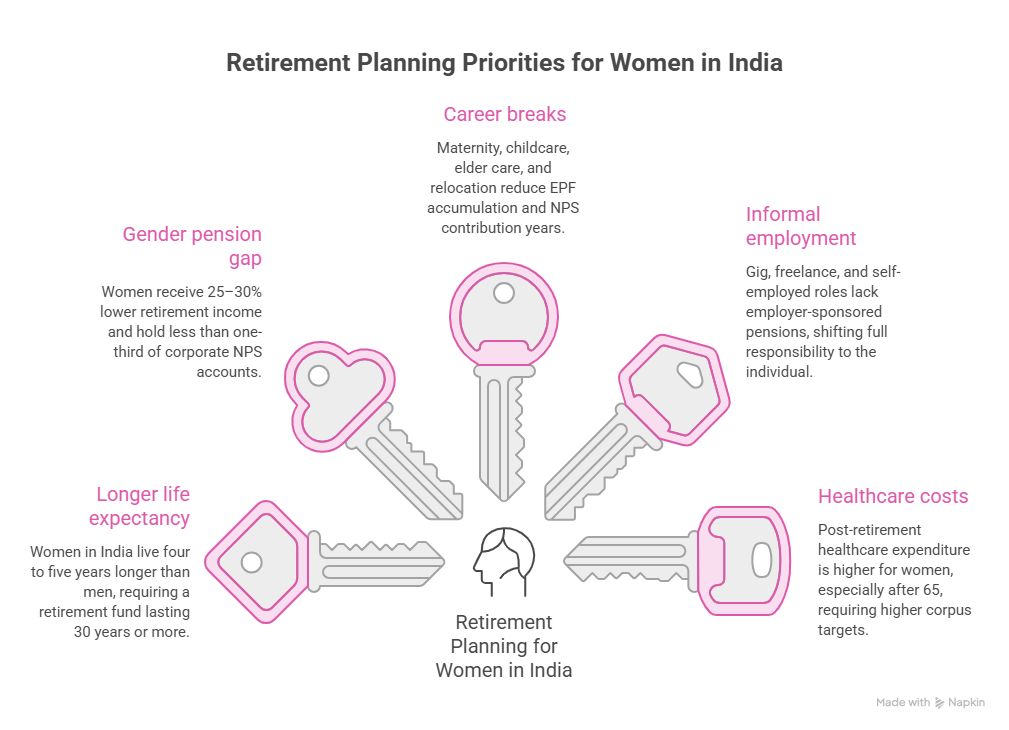
The specific financial conditions that shape retirement planning for women in India:
Finance Minister Nirmala Sitharaman at NPS Diwas 2025 called for training women as ‘Pension Sakhis’ — a women-led distribution channel to extend NPS access — reflecting that closing this gap is now a stated national policy priority.
The most widely used method for calculating a retirement corpus in India is the 25x rule: multiply expected annual retirement expenses by 25, assuming a 4% annual withdrawal rate that is sustainable for 25–30 years.
Simple approach: Take your expected monthly expenses in retirement and multiply by 300 (that’s 25 years × 12 months). Then apply inflation. If you expect to spend Rs. 50,000 per month today, that’s roughly Rs. 1.5 crore in today’s money — but at 6% inflation over 20 years, you’ll need closer to Rs. 4–5 crore. The key insight: start early, contribute consistently, and step up contributions as income grows. Time does the heavy lifting.
| Age Range | Recommended Savings Rate | Focus |
|---|---|---|
| 25 to 30 | 15% of net take-home | Building the habit; time is the primary asset |
| 31 to 40 | 20 to 25% of income | Scaling with income; step up SIPs annually |
| 41 to 50 | 30 to 40% of income | Acceleration phase: redirect freed cash flow |
| 51 to 58 | Preserve and rebalance | Shift toward debt; protect the corpus built |
For women with a career break in this timeline, savings rates immediately before and after the break should be higher to compensate for the lost contribution period.
NPS operates through two account types:
Contributions are managed by a Pension Fund Manager (PFM) you choose at registration — SBI Pension Funds, HDFC Pension, ICICI Prudential Pension, UTI Retirement Solutions, Kotak Pension, and others. Allocation across equity, corporate bonds, and government securities is chosen at opening and can be adjusted once per year.
Under the old tax regime, the key deduction sections available to women:
| Tax Section | Instrument | Annual Deduction Limit | Notes |
|---|---|---|---|
| Section 80C | EPF, PPF, ELSS, LIC, ELSS SIP | Rs. 1.5 lakh (combined ceiling) | Shared across all instruments |
| Section 80CCD(1) | NPS’s own contribution | Within 80C ceiling (10–20% of income) | Part of the Rs. 1.5 lakh limit |
| Section 80CCD(1B) | NPS’s own contribution | Rs. 50,000 additional | Exclusive to NPS; above 80C ceiling |
| Section 80CCD(2) | Employer NPS contribution | 14% of Basic + DA | Works under new tax regime too |
| Section 80D | Health insurance premium | Rs. 25,000 (self); Rs. 50,000 (senior parents) | Separate from 80C entirely |
Section 80CCD(1B) is the only deduction in India that sits entirely outside the Rs. 1.5 lakh 80C ceiling and is exclusive to NPS. No other instrument — PPF, ELSS, or LIC — provides access to this additional Rs. 50,000.
Salaried women: up to 10% of Basic + DA. Self-employed women: up to 20% of gross annual income. This sits within the Rs. 1.5 lakh 80C ceiling. Applies only under the old tax regime. (Source: Section 80CCD(1), Income Tax Act, 1961 — incometaxindia.gov.in)
An additional Rs. 50,000 deduction for NPS Tier I contributions, entirely above the 80C ceiling. Even if 80C is fully used by EPF contributions, this deduction remains available.
| Tax Slab | Additional NPS Contribution | Annual Tax Saved |
|---|---|---|
| 5% | Rs. 50,000 | Rs. 2,500 |
| 20% | Rs. 50,000 | Rs. 10,000 |
| 30% | Rs. 50,000 | Rs. 15,000 |
Over 20 years, a woman in the 20% slab saves Rs. 2 lakh in tax through this section alone, before counting compound growth on the contributed amount. Applies only under the old tax regime. (Source: Section 80CCD(1B), Income Tax Act, 1961 — incometaxindia.gov.in)
The employer’s NPS contribution is deductible under Section 80CCD(2), the only NPS deduction that applies to both the old and new tax regimes. Following Budget 2024, the employer contribution ceiling for private sector employees was raised from 10% to 14% of Basic + DA. Example: Rs. 60,000 basic salary with 14% employer NPS contribution = Rs. 1,00,800 per year, excluded from taxable income.
All returns within the NPS Tier I account — equity gains, bond interest, dividends — accumulate tax-free, with no annual capital gains or dividend distribution tax.
At exit (age 60), up to 80% of the corpus can be withdrawn as a lump sum (non-government subscribers). Note: Under current income tax law (Section 10(12A)), only 60% of the total corpus is tax-exempt at withdrawal; the additional 20% remains taxable until the Income Tax Act is updated. The remaining 20% is mandatorily annuitised; the pension received is taxable at the applicable slab. (Source: PFRDA Exit and Withdrawal Amendment Regulations, 2025)
| NPS Corpus at Retirement | Tax-Efficient Lump Sum (up to 80%*) | Annuity-Invested Amount (40%) |
|---|---|---|
| Rs. 30 lakh | Rs. 18 lakh | Rs. 12 lakh |
| Rs. 60 lakh | Rs. 36 lakh | Rs. 24 lakh |
| Rs. 1 crore | Rs. 60 lakh | Rs. 40 lakh |
| Rs. 2 crore | Rs. 1.2 crore | Rs. 80 lakh |
Exception: Per PFRDA Exit and Withdrawal Amendment Regulations 2025, if the total corpus is Rs. 8 lakh or less, the full amount can be withdrawn without purchasing an annuity.
NPS works best as one component of a broader retirement portfolio:
| Instrument | Expected Returns | Tax on Maturity | Lock-in | Best For |
|---|---|---|---|---|
| NPS Tier I | 9–12% (equity-heavy) | 60% tax-exempt (lump sum); up to 80% withdrawal allowed*; 20% annuity required | Until age 60 | Pension + Rs. 50,000 extra deduction |
| PPF | ~7.1% (fixed) | 100% tax-free (EEE) | 15 years | Risk-free debt anchor |
| Equity SIP | 10–13% (long-term avg.) | LTCG at 12.5% above Rs. 1.25L/yr | None | Flexible, high-growth |
| EPF / VPF | ~8.25% | Tax-free on maturity | Until exit | Salaried women |
| Sovereign Gold Bonds | ~8–10% | Capital gains exempt at maturity | 8 years | Inflation hedge (5–10%) |
| SCSS (post-60) | ~8.2% | Interest taxable; 80C deductible | 5 years | Safe post-retirement income |
Allocation for a woman in her late 20s or early 30s: 60–70% equity SIPs, 20–25% NPS and PPF combined, 10% liquid emergency fund. As she crosses 45, shift toward 50% equity and 50% debt. By 55–58, prioritize capital preservation, allocating 60%+ of the portfolio to debt instruments. A Rs. 5,000 monthly SIP started at 25, stepped up 10% annually, accumulates over Rs. 2.5 crore by age 60 at 12% average annual returns.
An NPS Tier I account does not close during periods of non-contribution. The corpus continues to grow in line with market performance. The only requirement to maintain an active status is a minimum annual contribution of Rs. 1,000. Upon returning to income, contributions resume without re-registration.
Any Indian citizen between 18 and 85 years can open a Tier I NPS account under the All Citizen Model, regardless of employment status.
Self-employed women: deduction under 80CCD(1) up to 20% of gross annual income (within 80C ceiling) + Rs. 50,000 under 80CCD(1B) = maximum Rs. 2 lakh annual NPS tax deduction under the old regime. No employer required.
Homemakers: can open and contribute independently, starting at Rs. 1,000 per year. Tax benefits apply to the extent of taxable income; even without taxable income, up to 60% of the corpus is tax-exempt at withdrawal (lump sum), with up to 80% withdrawable as lump sum under 2025 PFRDA rules for non-government subscribers.
For women in informal or low-income self-employment, two government schemes are relevant:
For women with taxable income and formal banking access, NPS offers significantly higher corpus potential and tax benefits. APY and PM-SYM are most relevant for domestic workers, street vendors, and agricultural laborers.
Active Choice: manual allocation across Scheme E (Equity, max 75% until age 50), Scheme C (Corporate Bonds), and Scheme G (Government Securities).
Auto Choice: Three Life Cycle Funds defined by PFRDA, allocation adjusts automatically with age:
| Life Cycle Fund | Equity at Age 35 | Suitable For |
|---|---|---|
| Aggressive LC75 | 75% | Women under 40, comfortable with market exposure |
| Moderate LC50 | 50% | Women 35–50, balanced growth and stability |
| Conservative LC25 | 25% | Women above 50, capital preservation priority |
NPS equity funds have historically delivered 9–12% annualized returns, while government securities and corporate bond schemes have delivered 7–9%. Allocation can be changed once per year at no charge.
Projection: 30-year-old woman contributing Rs. 5,000 per month, with contributions increasing 5% annually until age 60.
| Assumed Average Return | Estimated Corpus at 60 | Tax-Efficient Lump Sum (up to 80%*) |
|---|---|---|
| 8% per annum | ~Rs. 1.05 crore | ~Rs. 63 lakh |
| 10% per annum | ~Rs. 1.55 crore | ~Rs. 93 lakh |
| 12% per annum | ~Rs. 2.30 crore | ~Rs. 1.38 crore |
Illustrative projections only. Actual returns depend on fund performance and market conditions. Past NPS fund returns do not guarantee future results. *Per PFRDA Exit and Withdrawal Amendment Regulations, 2025: non-government subscribers can withdraw up to 80% as a lump sum; however, under current income tax law (Section 10(12A)), only 60% of the total corpus is tax-exempt. The additional 20% remains taxable until the Income Tax Act is amended.
| Feature | NPS | PPF |
|---|---|---|
| Maximum Annual Tax Deduction | Rs. 2 lakh (old regime) | Rs. 1.5 lakh (under 80C) |
| Annual Contribution Ceiling | None | Rs. 1.5 lakh |
| Returns | Market-linked (9–12% historically) | Government-fixed (~7.1% currently) |
| Tax on Maturity | 60% tax-exempt lump sum; up to 80% withdrawal (non-govt)*; 20% annuity mandatory | 100% tax-free (EEE) |
| Lock-in Period | Until age 60 | 15 years, extendable |
| Market Risk | Yes (equity component) | None |
| Works Under New Tax Regime | Partially (80CCD(2) only) | No |
PPF is fully EEE; contributions, growth, and maturity are all tax-free with zero market risk. NPS offers higher potential returns through equity exposure and the exclusive 80CCD(1B) deduction that PPF does not offer. Both serve different roles: PPF as the risk-free debt anchor, NPS for equity-linked long-term growth.
An NPS Tier I account can be opened online in under 30 minutes:
NPS accounts can also be opened through major banks (Points of Presence) or through platforms like Zerodha, Groww, or ET Money. All contributions, nominations, and fund switches are managed using the PRAN.
Retirement planning for women in India needs to account for a longer post-retirement period, irregular income patterns, career breaks, and a higher share of informal employment. Financial independence in retirement is not a default outcome; it is the result of a deliberate, long-horizon savings plan started early and adjusted as life changes.
NPS addresses several of these needs directly: flexible contributions that accommodate career breaks, a Rs. 50,000 deduction under Section 80CCD(1B) exclusive to NPS and available to both salaried and self-employed women, and a tax-efficient withdrawal structure at maturity — up to 80% as lump sum (non-government subscribers, per 2025 PFRDA regulations), with 60% tax-exempt under current income tax law — one of the most favourable large-corpus exit structures in any regulated Indian retirement product.
Used alongside PPF for risk-free debt accumulation and equity SIPs for flexible long-term growth, NPS forms the core of a well-structured retirement plan — whether you are starting at 25, resuming after a break at 38, or catching up at 50. For guidance specific to your income profile, tax situation, or investment horizon, a SEBI-registered investment adviser (fee-only, no product commission) is the appropriate next step.
 Talk to us
Investor Grievance
Talk to us
Investor Grievance


