
Investment options in India for NRIs include fixed deposits, mutual funds, listed equity, real estate, NPS, bonds, and government securities. For UK and US-based NRIs, the right route depends on the source of funds, NRE/NRO/FCNR accounts, FEMA rules, Indian tax treatment, repatriation needs, and UK or US reporting requirements.
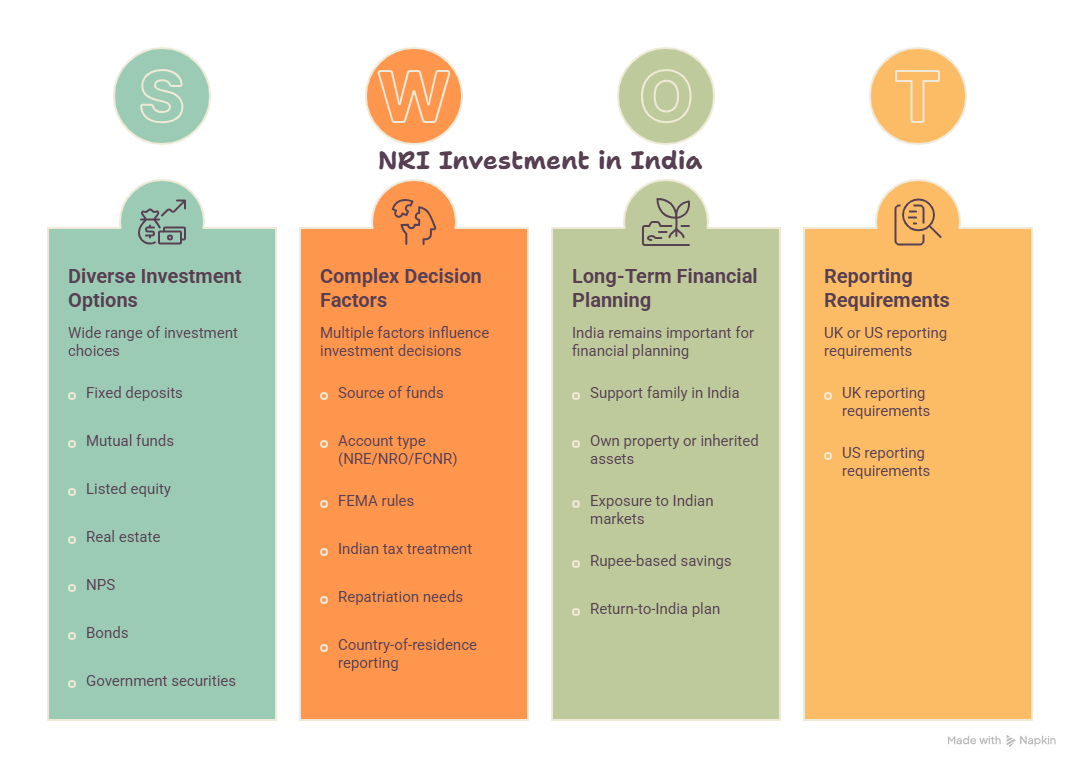
For many Indians living in the UK or the US, India remains an important part of long-term financial planning. Some continue to support parents or family members in India. Some own property or inherited assets. Others want exposure to Indian markets, rupee-based savings, or a possible return-to-India plan.
Investment decisions for NRIs differ from those of resident investors because every investment is tied to three important questions: where the money came from, which account is used, and whether the money may need to be transferred abroad later.
That is why investment options in India for NRIs should be reviewed alongside account types, tax treatment, FEMA rules, repatriation, and country-of-residence reporting.
For UK and US-based NRIs investing in India, the product is only one part of the decision. A fixed deposit, mutual fund, listed share, property, NPS account, or bond can receive different treatment depending on whether it is held in an NRE, NRO, or FCNR account.
Before comparing investment products, NRIs need to understand the account route. Most investments in India are linked to NRE, NRO, or FCNR accounts. These accounts are not the same, and using the wrong account can create tax, repatriation, and documentation issues later.
A Non-Resident External account is generally used for foreign income sent to India. The account is maintained in Indian rupees. Funds in an NRE account are generally repatriable, which means the balance can be transferred abroad through banking channels. Interest earned on NRE account balances may be exempt from Indian income tax when the conditions under Section 10(4)(ii) are met. NRE accounts are commonly used when money is earned in the UK, US, or another overseas country and transferred to India for investment.
A Non-Resident Ordinary account is generally used for income earned in India. This may include rent, pension, dividends, interest, sale proceeds, or other Indian receipts. Interest earned on an NRO account is taxable in India. Repatriation is permitted up to USD 1 million per financial year, subject to RBI limits, tax compliance, and documentation.
A Foreign Currency Non-Resident account allows eligible NRIs to hold deposits in permitted foreign currencies. This can be useful when an NRI does not want to convert foreign currency into Indian rupees immediately. For UK and US-based NRIs, FCNR accounts may help reduce currency conversion risk on the deposit amount, subject to bank terms and applicable rules.
The source of funds is one of the most important points in FEMA rules for NRI investment. Money earned abroad is treated differently from money earned in India.
For example, salary earned in the UK or the US and sent to India is generally routed through an NRE account. Rent received from Indian property is usually credited to an NRO account. Sale proceeds from Indian assets may also need to be routed through the appropriate account.
This matters because the source of funds can affect tax treatment, repatriation status, and the documentation required later. A common mistake is choosing the investment product first and checking the account route later. A better starting point is to identify whether the money is foreign-earned or India-sourced, and then decide the account and investment route.
Repatriation means transferring money from India to an overseas bank account. This is important for NRIs because some investments may be held for India-linked goals, while others may need to be moved back to the UK or the US later.
NRE and FCNR balances are generally repatriable. NRO balances are more restricted. As per RBI guidance, balances in NRO accounts and eligible assets may be remitted up to USD 1 million per financial year, subject to applicable taxes and documentation.
Repatriation rules for NRIs are especially relevant for rental income, NRO fixed deposits, inherited assets, property sale proceeds, dividends, and sale proceeds from Indian investments. This should be checked before investing, not only when the investor wants to withdraw or transfer money.
Fixed deposits are among the commonly considered investment options in India for NRIs because they are easier to understand and directly linked to the account type.
NRE fixed deposits are opened using foreign income transferred to India and are held in Indian rupees. Interest may be exempt from Indian income tax when applicable conditions are met, and principal and interest are generally repatriable. However, because NRE fixed deposits are maintained in Indian rupees, currency movement can affect the final value when funds are converted back into GBP or USD.
NRO fixed deposits are used for India-sourced income such as rent, pension, dividends, or other Indian receipts. Interest is taxable in India and TDS may apply. Repatriation is allowed but subject to RBI rules, tax compliance, and documentation. NRO fixed deposits may be useful for managing Indian income, but they do not have the same repatriation treatment as NRE deposits.
FCNR deposits are held in permitted foreign currencies and may be relevant for NRIs who want a deposit option without immediately converting money into Indian rupees. For UK- and US-based NRIs, FCNR deposits can be reviewed when currency movement is a key consideration.
NRIs can invest in Indian mutual funds through permitted routes, generally using an NRE or NRO bank account. The investor must complete KYC and meet the asset management company’s requirements. Indian mutual funds may provide exposure to equity, debt, hybrid, or other fund categories depending on the scheme selected. NRIs should check whether the investment is being made on a repatriable or non-repatriable basis, how gains will be taxed in India, and whether TDS applies at redemption.
US-based NRIs need extra review before investing in Indian mutual funds. Some Indian asset management companies may restrict investments by US- and Canada-based investors due to additional compliance requirements. From a US tax perspective, Indian mutual funds may also create additional reporting requirements linked to PFIC rules. The IRS provides information on Form 8621. This does not mean that US-based NRIs cannot invest in Indian mutual funds. It means AMC eligibility, Indian tax treatment, and US reporting requirements should be checked before investing.
NRIs may invest in listed Indian shares through permitted routes. This typically requires a bank account, a demat account, a trading account, and a SEBI-registered broker. The NRI portfolio investment scheme route is important because NRI investments in Indian companies are subject to RBI and SEBI rules. The route may differ depending on whether the investment is made on a repatriable or non-repatriable basis. Capital gains from listed shares can be taxable in India. Dividends are also taxable in the hands of the investor. TDS may apply depending on the type of income and the applicable provisions.
Real estate remains one of the most important India-linked assets for many NRIs. UK and US-based Indians may already own property in India or may consider buying residential or commercial property for family use, rental income, or future return.
RBI guidance allows NRIs and OCIs to generally acquire residential and commercial property in India. However, agricultural land, plantation property, and farmhouse property are generally restricted. RBI’s property FAQ explains the rules for purchasing immovable property.
Rental income from Indian property is taxable in India and is usually credited to an NRO account. If the property is sold, capital gains may be taxable in India depending on the holding period and applicable tax provisions. Sale proceeds may be repatriated subject to FEMA rules, tax compliance, and documentation. The key points to check are property type, source of funds, tax on rent, tax on sale, and repatriation of sale proceeds.
The National Pension System is a retirement-focused product regulated by PFRDA. As per PFRDA’s All Citizen Model, Indian citizens, including resident and non-resident Indians, and OCIs may subscribe to NPS if they meet age and KYC requirements. PFRDA currently states the eligible age range as 18 to 85 years. NPS is structured for long-term retirement planning and comes with exit and withdrawal rules. It is not designed as a short-term liquidity product. For UK- and US-based NRIs, NPS may need to be reviewed from both the Indian tax and the country-of-residence tax perspectives before contributing.
Government securities and corporate bonds should not be treated as the same. Government securities carry sovereign backing, while corporate bonds carry issuer-level credit risk. Interest income may be taxable in India, and TDS may apply depending on the instrument.
The RBI Retail Direct platform provides access to government securities. Eligibility and permitted routes should be checked through the latest RBI rules before investing. Fixed-income products may be useful for income planning or portfolio stability, but NRIs should review product eligibility, tenure, liquidity, taxation, TDS, credit risk, and repatriation route.
Gujarat International Finance Tec-City, or GIFT City, houses India’s International Financial Services Centre (IFSC). The IFSC at GIFT City operates under a separate regulatory framework governed by the International Financial Services Centres Authority (IFSCA), and has become a significant destination for NRI investments.
Non-residents investing through IFSC-registered entities may be exempt from capital gains tax in India on certain investments, subject to conditions under the Income Tax Act and applicable IFSCA regulations. This makes GIFT City particularly relevant for NRIs who want exposure to Indian markets while managing their Indian tax position.
Investment options available through GIFT City IFSC include fund products, portfolio management services, alternative investment funds, and certain debt instruments. Transactions through IFSC are typically conducted in foreign currency, which can reduce currency conversion steps for UK- and US-based NRIs. The repatriation framework within GIFT City is also generally more straightforward than standard NRO routes.
GIFT City is still an evolving platform and the range of products, eligible intermediaries, and applicable rules continue to develop. NRIs considering GIFT City should review the current IFSCA regulations, confirm product eligibility, and check how any gains or income from GIFT City investments may be treated in the UK or US.
For UK-based NRIs, Indian investment income may also be subject to UK tax. GOV.UK states that UK residents normally pay UK tax on foreign income, depending on residence status and applicable rules. Indian interest, dividends, rental income, and capital gains may need to be reviewed under UK foreign income rules. The India-UK DTAA may help in cases where the same income is taxed in both India and the UK.
Under the Common Reporting Standard (CRS), India shares financial account information with participating countries, including the UK. UK-based NRIs who hold accounts in India are required to submit a CRS declaration when setting up those accounts. This confirms tax residency status and ensures account information is shared with the relevant tax authority in the country of residence.
For US-based NRIs, Indian investments may involve additional reporting. The IRS states that US citizens and resident aliens are generally taxed on worldwide income. This can include interest, dividends, rent, capital gains, and other income from Indian assets.
FinCEN states that a US person must file an FBAR if the aggregate value of foreign financial accounts exceeds USD 10,000 at any time during the calendar year. IRS Form 8938 may also apply when specified foreign financial assets cross the applicable reporting threshold. Indian mutual funds may require additional caution for US-based investors due to PFIC-related reporting.
Under FATCA, India shares financial account information held by US persons with the United States. US-based NRIs are generally required to submit a FATCA declaration when opening or maintaining accounts in India. This confirms US person status and allows Indian financial institutions to report account details to the IRS through the India-US intergovernmental agreement.
DTAA for NRI investors becomes relevant when the same income is taxable in India and also reportable in the country of residence. India has Double Taxation Avoidance Agreements with both the UK and the US. DTAA does not automatically make income tax-free. It may help through a foreign tax credit, reduced withholding, or allocation of taxing rights, depending on the treaty and the type of income. To claim treaty benefits in India, documentation such as a Tax Residency Certificate and Form 10F may be required.
| Investment Option | Common Use | Indian Tax Point | Repatriation Point | Key Check |
|---|---|---|---|---|
| NRE Fixed Deposit | Foreign-earned money sent to India | Interest may be exempt if conditions are met | Generally repatriable | Currency movement between INR and GBP/USD |
| NRO Fixed Deposit | Income earned in India | Interest taxable, TDS may apply | Subject to RBI limits and documents | Used for rent, pension, dividends, and Indian receipts |
| FCNR Deposit | Foreign currency deposits | Tax treatment depends on eligibility and status | Generally repatriable | Available only in permitted foreign currencies |
| Mutual Funds | Indian equity, debt, or hybrid exposure | Capital gains taxable, TDS may apply | Depends on NRE/NRO route | US-based NRIs should check AMC and PFIC-related rules |
| Direct Equity | Listed Indian shares | Capital gains and dividends taxable | Depends on account and route | Demat, broker, bank, and tax setup |
| Real Estate | Residential or commercial property | Rent and capital gains taxable | Sale proceeds subject to FEMA rules | Agricultural land, plantation property, and farmhouse restrictions |
| NPS | Retirement planning | Tax treatment depends on applicable provisions | Withdrawal rules apply | Long-term product with exit conditions |
| Bonds / G-Secs | Fixed-income exposure | Interest taxable, TDS may apply | Depends on product and account route | Credit risk, tenure, eligibility, and liquidity |
| GIFT City (IFSC) | Foreign currency investments through IFSC entities | Capital gains may be exempt on certain investments, subject to IFSCA conditions | Generally more straightforward than standard NRO routes, in foreign currency | Confirm IFSCA product eligibility and UK/US treatment of GIFT City income |
Before investing, UK and US-based NRIs can review the following points:
For a full picture of the Indian tax framework that underpins these investment decisions, see our NRI Tax Guide 2026, covering residential status rules, DTAA documentation, and return filing requirements.
UK and US-based NRIs have multiple investment options in India, including fixed deposits, mutual funds, listed equity, real estate, NPS, bonds, government securities, and GIFT City investments through IFSC-registered entities. Each option has a different role, account route, tax treatment, repatriation position, and documentation requirement.
The right comparison depends on the source of funds, residential status, account type, Indian tax rules, FEMA treatment, and reporting requirements in the UK or US. For US-based NRIs, foreign account reporting and mutual fund-related tax treatment may need closer review. For UK-based NRIs, Indian income and gains may need to be checked under UK foreign income rules.
A structured review of NRE, NRO, and FCNR accounts, repatriation, DTAA provisions, TDS, FATCA and CRS declaration requirements, GIFT City eligibility, and country-of-residence reporting can help NRIs compare India-linked investment options with better clarity.
 Talk to us
Investor Grievance
Talk to us
Investor Grievance


