
India’s CPI inflation in June 2026 reached 4.38%, impacting fixed deposits, bond yields, and real returns. Investors should consider short-duration bonds, floating-rate instruments, equities with pricing power, and gold to protect their portfolio against rising prices.
India’s retail inflation has moved past the Reserve Bank of India’s 4% target. According to the Ministry of Statistics and Programme Implementation (MoSPI), the Consumer Price Index (CPI) based inflation rate for June 2026 stood at 4.38% year-on-year, up from 3.93% in May and marking the sixth straight monthly increase under the new CPI series (base year 2024). Rural households felt the pressure more, with rural inflation at 4.74% against 3.92% in urban areas.
For anyone with savings in a fixed deposit, a mutual fund, or a government bond, this number is not just a headline. It changes what your money is actually worth, and it changes how bonds behave in the market. Here is what is happening, and what it means for your savings and investment plan.
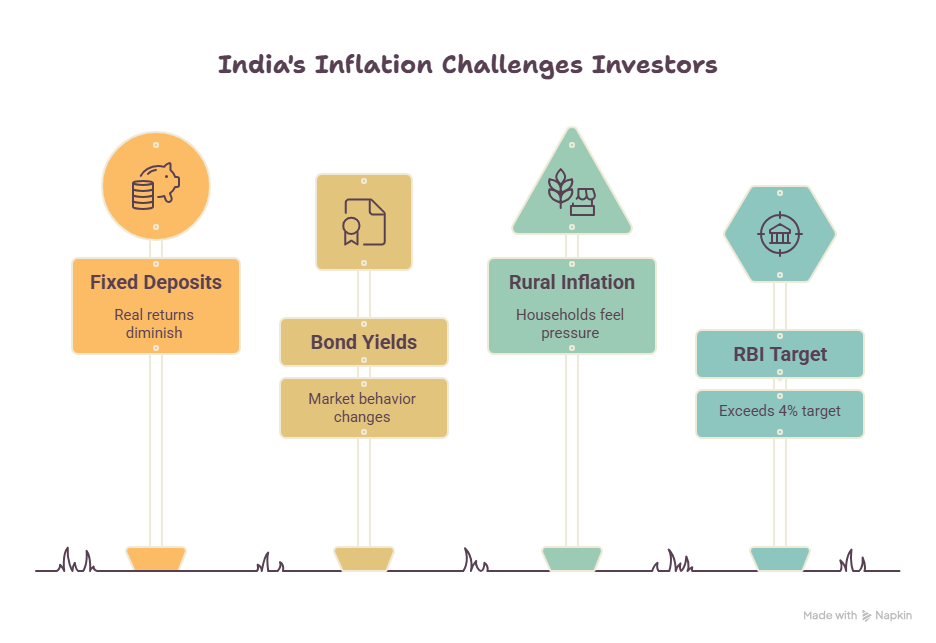
Food prices are the main driver behind the recent rise. The Consumer Food Price Index (CFPI) climbed to 5.32% in June 2026, compared to 4.78% in May, as reported by MoSPI. Housing inflation, by contrast, remained mild at 2.10% for the same month.
Under India’s flexible inflation targeting framework, the government has set a CPI inflation target of 4%, with a tolerance band of 2% on either side, meaning the RBI treats anything between 2% and 6% as an acceptable range, according to the Reserve Bank of India. A reading of 4.38% is therefore still within the tolerance band, but it sits above the midpoint target, which is why the RBI’s own projections for the year matter. The central bank’s Monetary Policy Committee has projected inflation averaging around 5.1% for FY 2026-27, with quarterly estimates of 4.2%, 5.1%, 5.9% and 5.9% across the four quarters, according to its June 2026 policy statement.
The RBI held its repo rate at 5.25% at its June 2026 meeting, keeping the Standing Deposit Facility rate at 5.0% and the Marginal Standing Facility rate at 5.50%, while adopting a neutral policy stance.
CPI trend, last 6 months (base year 2024 series):
Jan 2026: 2.75% · Feb 2026: 3.21% · Mar 2026: 3.40% · Apr 2026: 3.48% · May 2026: 3.93% · Jun 2026: 4.38%
(The 2024-base series only launched in February 2026, so this six-month run is the longest directly comparable stretch — a longer lookback would mix two different CPI bases.)
Inflation reduces what a fixed amount of money can buy over time. If your savings account or fixed deposit pays 6% interest and inflation runs at 4.4%, your real return — the return after adjusting for rising prices — is only around 1.6%. This is the core reason inflation matters for every kind of investor, not just bond holders.
Cash and fixed deposits: These lose purchasing power fastest during inflationary periods, since their returns are fixed at the time of booking and do not adjust upward when prices rise mid-tenure.
Equities: Stocks of companies that can pass on higher costs to customers, such as those in consumer staples or utilities, tend to hold up better. Companies with thin margins or heavy input costs usually struggle when input prices rise faster than what they can charge customers.
Gold: Gold has historically acted as a hedge against inflation and currency depreciation. This has been visible in 2026, when silver jewellery prices rose 133.21% year-on-year and gold, diamond, and platinum jewellery recorded a combined inflation print of 36.82% in June, according to MoSPI data reported through official sources.
Real estate: Property values and rental income often rise along with general price levels over the long term, though this depends heavily on location and demand.
Debt mutual funds and bonds: These are the most directly affected by inflation because bond prices and interest rates move in opposite directions, which is worth unpacking on its own.
Bonds pay a fixed rate of interest, called the coupon, for a set period. When inflation rises, the RBI typically responds by raising interest rates to cool down spending and bring prices back toward the target. New bonds are then issued at these higher rates.
This creates a chain reaction. If new government securities are being issued at a higher yield because the RBI has tightened policy, an older bond paying a lower fixed coupon becomes less attractive. To find a buyer, the price of that older bond has to fall until its effective yield matches what new bonds are offering. This is the inverse relationship between bond prices and yields that every bond investor eventually has to deal with.
The reverse also holds. When inflation cools and the RBI lowers rates, existing bonds with higher fixed coupons become more valuable, and their prices rise.
Bonds with longer maturities are more sensitive to this seesaw because their fixed payments are locked in for a longer stretch of time. Short-duration instruments, such as treasury bills or bonds maturing within a year, are less affected, since investors can reinvest at new rates sooner.
During a period of rising prices, three practical effects show up in the bond market:
This is why fixed-income investors often shift toward shorter maturities or floating-rate instruments when inflation is trending upward, since these adjust faster to changing conditions instead of locking in a rate that could quickly fall behind rising prices.
India has a few instruments designed specifically to reduce this inflation risk for fixed-income investors.
RBI Floating Rate Savings Bonds, 2020 (Taxable): These are non-tradable, government-backed bonds where the coupon rate resets every six months, linked to the prevailing National Savings Certificate (NSC) rate plus a fixed spread of 0.35%. As of the January to June 2026 reset cycle, the rate stood at 8.05% per annum, and the RBI updated the operational guidelines for these bonds in April 2026 to add digital servicing features, according to the Reserve Bank of India’s notification. Because the rate moves with NSC revisions, which the government reviews periodically, these bonds offer some built-in protection against rising rates, though not a direct link to the CPI itself.
Capital Indexed Bonds and Inflation Indexed Bonds: The RBI has, in the past, issued capital-indexed and inflation-indexed government securities where the principal itself is adjusted in line with CPI movements, so both the payout and the redemption value keep pace with inflation. These instruments are typically issued for institutional investors rather than being generally available to retail investors, unlike the Floating Rate Savings Bonds.
Short-duration debt funds and Treasury Bills: For retail investors who want inflation-aware fixed income without picking individual bonds, short-duration government treasury bills and low-duration debt mutual funds reset closer to prevailing rates and carry less price risk than long-term bonds.
| Instrument | Rate type | Response to rising inflation | Typical tenure | Retail access |
|---|---|---|---|---|
| Bank Fixed Deposits | Fixed | Rate locked at booking; real return shrinks as CPI rises | 7 days – 10 years | High |
| Govt/corporate bonds (fixed coupon) | Fixed | Market price falls as yields rise; coupon unchanged | 1 – 30 years | Moderate (demat, bond platforms, debt funds) |
| RBI Floating Rate Savings Bonds, 2020 | Floating (resets every 6 months, NSC + 0.35%) | Adjusts with NSC revisions; partial, indirect protection | 7 years, non-tradable | High |
| Capital / Inflation Indexed Bonds | Principal linked to CPI | Principal and payout rise directly with inflation | ~10 years (institutional) | Low |
| Short-duration debt funds / T-Bills | Market-linked, resets quickly | Reinvests at prevailing rates sooner; lower price risk | Under 1 – 3 years | High |
Beyond investment portfolios, sustained inflation above the RBI’s 4% target has wider effects. Household budgets stretch further for daily essentials, since food carries the largest weight in the CPI basket. Borrowing costs stay elevated for longer if the RBI holds rates to control price pressures, which affects home loan and personal loan EMIs. Fuel price movements also matter directly, since state-owned oil marketing companies raised petrol and diesel prices four times in May 2026, the first such increases in four years, which pushed transport inflation from -0.01% in April to 1.75% in May.
For savers, the practical takeaway is that a return that looks reasonable on paper may not be keeping pace with what things actually cost. A fixed deposit at 6.5% and inflation at 4.4% still leaves a real return of roughly 2%, before tax. Once tax on interest income is factored in, that real return narrows further for many investors.
For long-horizon goals like retirement, inflation’s effect compounds in a way that a single year’s CPI print doesn’t fully convey. Using the rule of 70 — dividing 70 by the inflation rate — a sustained inflation rate of around 6% roughly halves the purchasing power of a static retirement corpus every 11 to 12 years. A corpus that comfortably covers living expenses at retirement can fall well short two decades in, particularly if a large share of it sits in fixed-income instruments earning returns close to the inflation rate itself. Retirement planning therefore needs to account for inflation-adjusted withdrawal rates, not just a target corpus number, and typically calls for maintaining some exposure to equities or other growth assets even after retirement begins, since fixed deposits and bonds alone rarely outpace inflation by a meaningful margin over 20 to 30 years.
Recurring savings such as SIPs and recurring deposits face a related but distinct issue. A fixed monthly contribution decided today is based on today’s cost of living and today’s goal value. As prices rise, that same contribution buys a shrinking share of the eventual target, whether the goal is a child’s education, a home down payment, or a retirement fund. Investors commonly address this with a step-up or top-up SIP, where the contribution amount increases each year, often in line with expected income growth or inflation, rather than staying flat for the entire investment horizon. Even a modest annual step-up compounds meaningfully over a 15 to 20 year window and helps a recurring contribution keep pace with a target that itself grows with inflation.
The broader takeaway: inflation isn’t just a monthly headline figure that moves short-term bond prices — it changes what “enough” means for a goal set 10, 20, or 30 years out. Revisiting the size of a retirement corpus, the growth rate of recurring contributions, and the split between inflation-sensitive fixed income and growth-oriented assets matters more the longer the time horizon, since small underestimates of inflation compound into large shortfalls over decades.
There is no single fix for inflation risk, since different instruments respond to rising prices in different ways. A few points worth keeping in mind:
India’s CPI inflation crossing 4.38% in June 2026 is a signal worth paying attention to, even though it remains within the RBI’s tolerance band. It affects the real value of your savings, the direction of bond prices, and the returns you can expect from fixed income over the coming months. Bonds and inflation move in a clear, well-documented relationship: rising prices tend to push yields up and existing bond prices down, while floating-rate and inflation-linked instruments are built to absorb some of that shock. Reviewing your fixed-income mix, keeping an eye on RBI policy decisions, and matching your investment horizon to where inflation is headed will matter more in the months ahead than in periods when prices are stable.
 Talk to us
Investor Grievance
Talk to us
Investor Grievance


