


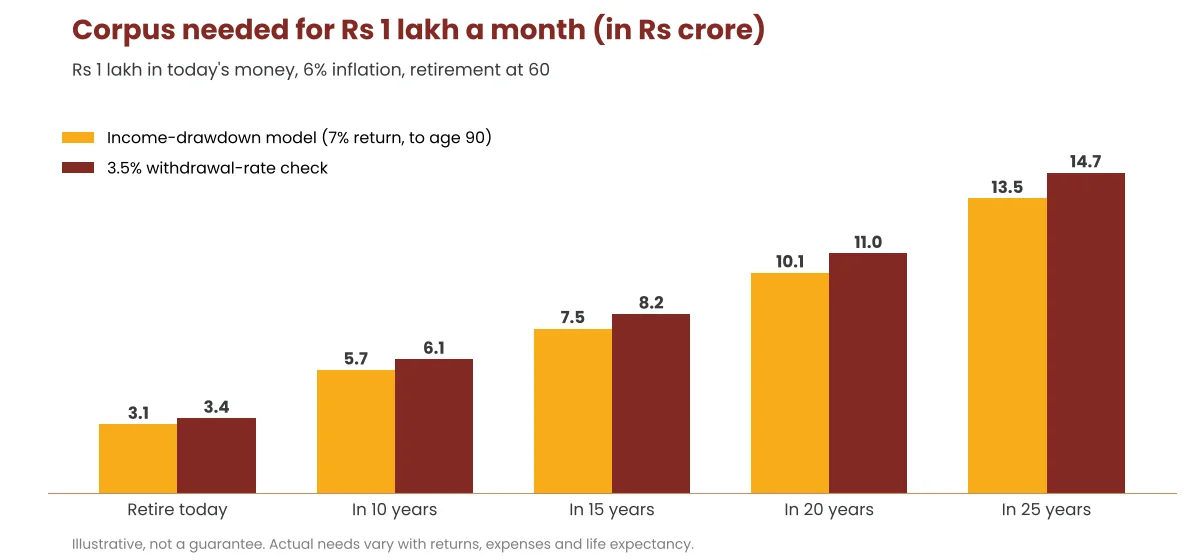
The corpus required for Rs 1 lakh monthly income is about Rs 3 crore to Rs 3.6 crore if you retire today at 60 and plan until 90. At 6% inflation, retiring in 20 years needs about Rs 10 crore to Rs 11 crore. Your exact number depends on returns, inflation and your withdrawal rate.
Whether you are retiring soon or plan to retire after a few years, generating a monthly income of Rs 1 lakh will not happen automatically. It requires planning and effort.
A retirement corpus is the lump sum you build before you stop working so that it can pay your expenses afterwards. In this guide, a monthly income of Rs 1 lakh (Rs 1,00,000, or 100000 a month) means Rs 1 lakh in today's purchasing power, not a fixed amount that loses value every year.
If you are starting your career, the goal is very achievable. If you are in your 40s or 50s, you will need to be more focused. Below we cover the corpus for each case, the pension options available in India today, how to invest the corpus, and the monthly SIP that gets you there.
Key takeaways
- Retire today at 60: about Rs 3 crore to Rs 3.6 crore covers Rs 1 lakh a month for 25 to 30 years.
- Retire in 20 years: Rs 1 lakh becomes Rs 3.21 lakh a month, and the corpus rises to about Rs 10 crore to Rs 11 crore.
- A pension is something you build: NPS, an annuity, SCSS and mutual fund SWP can each supply part of the Rs 1 lakh.
- Time matters most: starting from zero, a 25-year runway needs about Rs 85,000 a month, a 10-year runway about Rs 2.58 lakh.
How much corpus is required for Rs 1 lakh monthly income?
If you retire today at 60, the money required to retire in India with Rs 1 lakh a month in today's terms is roughly Rs 3 crore to Rs 3.6 crore. That assumes 6% inflation and a portfolio return of 6% to 8% after retirement. A quick cross-check agrees: at a 3.5% first-year withdrawal, Rs 12 lakh a year needs about Rs 3.43 crore.
Key assumptions: inflation, life expectancy and returns
- Inflation: we use 6% a year for all retirement years. The RBI's October 2026 Monetary Policy Report puts 2026-27 CPI inflation at 5.2%, and retail inflation was 5.54% in September 2026, so 6% is a sensible planning figure.
- Life expectancy: it is one of the most important inputs, so be conservative. The earlier version of this blog suggested 85 years. We now plan to age 90, because many people live longer than the average.
- Returns: a balanced portfolio of equity and debt is assumed to earn 6% to 8% a year after retirement. Cash flows are modelled with each year's withdrawal taken at the start of the year, which is the cautious choice.
| Return after retirement | Plan to age 85 (25 years) | Plan to age 90 (30 years) |
|---|---|---|
| 6% a year | Rs 3.00 crore | Rs 3.60 crore |
| 7% a year | Rs 2.69 crore | Rs 3.15 crore |
| 8% a year | Rs 2.42 crore | Rs 2.78 crore |
| 3.5% withdrawal rule | Rs 3.43 crore | Rs 3.43 crore |
Illustrative, not a guarantee. Rs 1 lakh a month in today's money, retiring now, with expenses rising 6% a year.
Retirement calculations in three simple steps
- Inflate your expense to the year you retire: monthly expense x 1.06 to the power of the years left.
- Find the corpus that can fund that spending for 25 to 30 years. Either divide the first-year annual spending by 3.5%, or use a drawdown model like the table above.
- Add a cushion for healthcare, a long life and a poor market year, then subtract income you already expect, such as EPF, NPS annuity or rent.
Corpus needed for other monthly income levels
| Monthly income (today's value) | Drawdown model (7%, to 90) | 3.5% withdrawal check |
|---|---|---|
| Rs 15,000 | Rs 47 lakh | Rs 51 lakh |
| Rs 50,000 | Rs 1.58 crore | Rs 1.71 crore |
| Rs 75,000 | Rs 2.36 crore | Rs 2.57 crore |
| Rs 1 lakh | Rs 3.15 crore | Rs 3.43 crore |
| Rs 1.5 lakh | Rs 4.73 crore | Rs 5.14 crore |
| Rs 2 lakh | Rs 6.30 crore | Rs 6.86 crore |
For a couple, start from your combined household spending. Remove costs that will end, such as EMIs and school fees, add healthcare, and then use the table. Our guide on how Indian couples should plan retirement together walks through this.
How does inflation change your Rs 1 lakh retirement target?
If you are looking for Rs 1 lakh monthly income, the first thing to be careful about is time. For example, if your monthly expenses are Rs 1 lakh today and you want to retire after 20 years, assuming 6% inflation, you will need Rs 3.2 lakh per month to have the same living standard. If your current expense is Rs 30,000 and you retire in 20 years, you will need about Rs 1 lakh.
Even after you retire, prices keep rising (see our note on the cost of living after retirement). If you are 60 today and think Rs 1,00,000 a month is sufficient, you are mistaken. By 70 you will need about Rs 1.8 lakh to buy the same things, and by 80 about Rs 3.2 lakh. Inflation is also running hot right now: the RBI raised rates in October 2026 after energy and weather shocks pushed prices up.
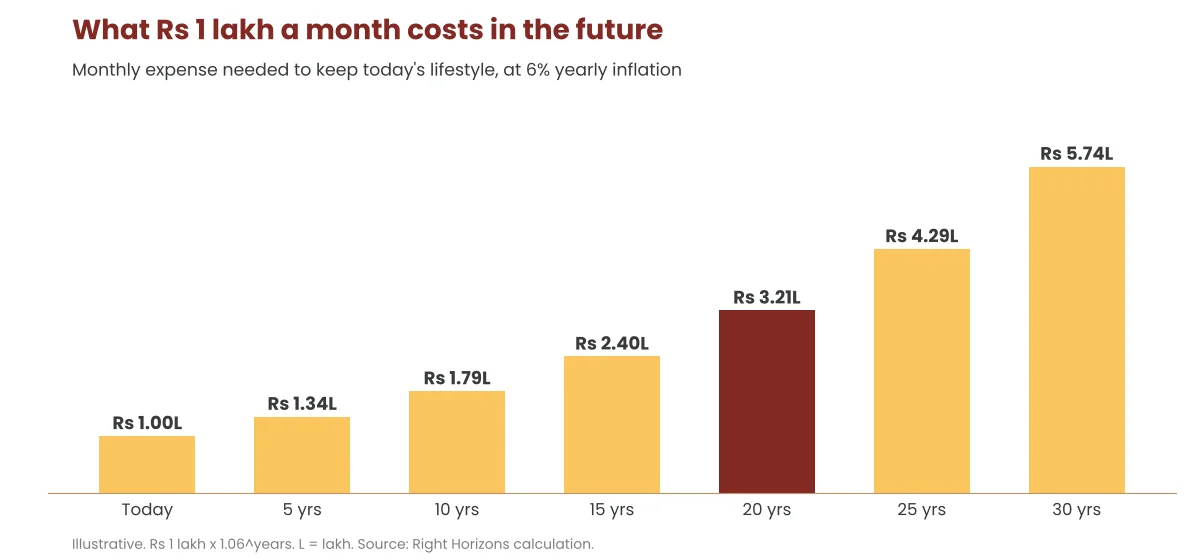
| Years to retirement | Rs 1 lakh becomes (a month) | Corpus: drawdown model | Corpus: 3.5% check |
|---|---|---|---|
| Today | Rs 1.00 lakh | Rs 3.15 crore | Rs 3.43 crore |
| 5 years | Rs 1.34 lakh | Rs 4.22 crore | Rs 4.59 crore |
| 10 years | Rs 1.79 lakh | Rs 5.65 crore | Rs 6.14 crore |
| 15 years | Rs 2.40 lakh | Rs 7.55 crore | Rs 8.22 crore |
| 20 years | Rs 3.21 lakh | Rs 10.11 crore | Rs 11.00 crore |
| 25 years | Rs 4.29 lakh | Rs 13.53 crore | Rs 14.71 crore |
Illustrative. 6% inflation, 7% return after retirement, plan to age 90. The first number a calculator gives you is rarely your number. Re-run it every two to three years.
How to get Rs 1 lakh pension per month: which options work?
Unless you have a government pension, a pension of Rs 1 lakh a month is something you build yourself. You do it by saving a corpus before retirement and then turning it into income with one or more tools. No single product usually does the whole job, so most plans combine two or three.
NPS: the new 80:20 exit rule for non-government staff
Since December 2025, non-government NPS subscribers with a corpus above Rs 12 lakh can take up to 80% as a lump sum and must put at least 20% into an annuity. The earlier rule was 60:40. Government employees still follow separate rules. The smaller annuity means more of your NPS corpus stays free for SWP, but a smaller annuity also means a smaller guaranteed pension. See our guide on whether you should invest in NPS.
Annuity, SCSS and SWP: how the options compare
| Option | How income arrives | What to watch |
|---|---|---|
| NPS plus annuity | Annuity pays for life after exit; rest of the corpus can be withdrawn | Annuity income is taxable and is usually fixed, so inflation erodes it |
| Annuity plan | Regular payout for life, often fixed from day one | Payout rate depends on age and plan. Compare options before buying |
| SCSS (age 60+) | 8.2% a year for July to September 2026, paid quarterly, up to Rs 30 lakh | Rate is reviewed every quarter. Rs 30 lakh gives about Rs 20,500 a month, interest is taxable |
| Mutual fund SWP | You set a monthly withdrawal from a fund. Only the gains in each withdrawal are taxed | Not guaranteed. Poor markets early in retirement can hurt, so keep a cash bucket |
Here is how that can look in practice. Rs 30 lakh in SCSS gives about Rs 20,500 a month. A 20% annuity slice of an NPS corpus adds a fixed income for life. An SWP from the rest of your corpus fills the gap and can be stepped up each year for inflation. Our guides to annuities in India and pension plans in India explain each in more detail.
How to invest your corpus for a monthly income retirement plan
One of the biggest mistakes most retired people make is to invest all their corpus in debt with low returns. Given high inflation, those returns may not beat inflation. Retirement can last 20 to 30 years or more, and all your funds will not be needed immediately, so a certain part can go into equity.
How much equity depends on how much risk you are ready to take. Within equity, there are some safer options, and a mix of debt and equity can give inflation-beating returns. A simple way to organise a monthly income retirement plan is the three-bucket approach below. Our guides to investment options for retirees and strategies for a retirement plan with regular income have more ideas.
The three-bucket approach to retirement income
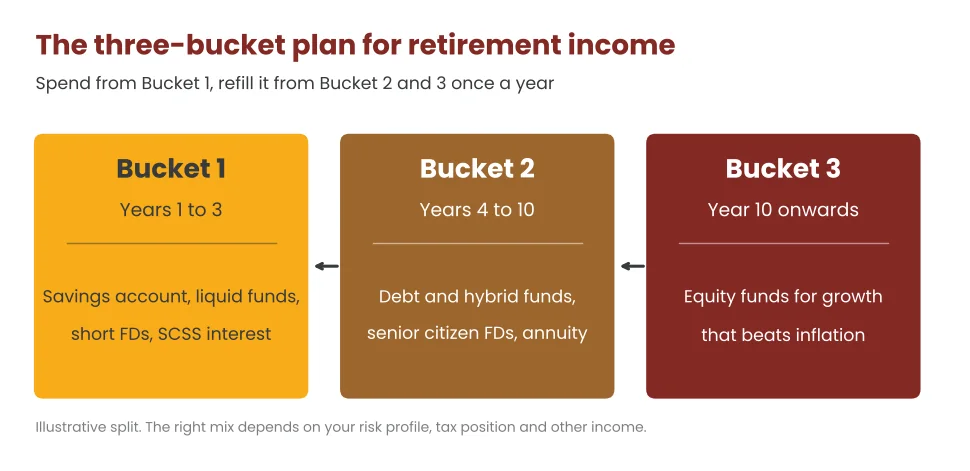
- Bucket 1 (years 1 to 3): the spending you need soon, kept in a savings account, liquid funds, short FDs or SCSS interest.
- Bucket 2 (years 4 to 10): debt and hybrid funds, senior citizen FDs or an annuity for steadier growth.
- Bucket 3 (year 10 onwards): equity funds that grow ahead of inflation. Move money down the buckets once a year.
Plan separately for healthcare costs and taxes
Medical costs tend to rise faster than general prices, so keep a health cover in place and a separate buffer outside the Rs 1 lakh budget. Read our guide to health insurance for retirees. Also work out the tax on each income stream, because interest, annuity and SWP gains are taxed differently. Our guide to tax planning for retirement in India helps.
How much should you invest each month to build this corpus?
The monthly amount depends mostly on how many years you have. The table assumes you start from zero and earn 11% a year, which needs an equity-heavy portfolio. Counting EPF, NPS and other savings you already hold will bring the figure down.
| Years to retirement | Corpus target (drawdown model) | Monthly SIP from zero (11%) |
|---|---|---|
| 10 years | Rs 5.65 crore | Rs 2.58 lakh |
| 15 years | Rs 7.55 crore | Rs 1.65 lakh |
| 20 years | Rs 10.11 crore | Rs 1.16 lakh |
| 25 years | Rs 13.53 crore | Rs 85,000 |
Illustrative and not guaranteed. Returns vary and markets can fall. Review yearly.
What if you are already in your 40s or 50s?
If you are in your 40s or 50s and have decided to start a plan now, you will have to work hard. Raise your SIP every year with a step-up, use any bonus or ESOP proceeds, and check whether Rs 1 lakh is truly the right target. Even a lower income goal, say Rs 75,000, cuts the corpus by about a quarter. Our guides on when to start planning for retirement and building a Rs 5 crore retirement corpus help here. You can also try our retirement readiness score.
Conclusion
The corpus required for Rs 1 lakh monthly income is not one fixed number. It is about Rs 3 crore to Rs 3.6 crore if you retire today, and Rs 10 crore or more if you retire in 20 years. There are too many variables to track alone, such as inflation, returns, taxes and health costs, and our complete guide to retirement planning in India covers the wider picture. At Right Horizons, our financial planning services turn these assumptions into a plan you can follow.
 Talk to us