
The Reserve Bank of India’s Monetary Policy Committee has kept the repo rate unchanged through multiple consecutive meetings in 2026, choosing to hold rather than cut or hike. For anyone with a home loan, a fixed deposit, or a borrowing decision on the horizon, this pause has direct, practical consequences. This article explains what the RBI repo rate 2026 decision actually means, and what it changes and doesn’t change for your money.
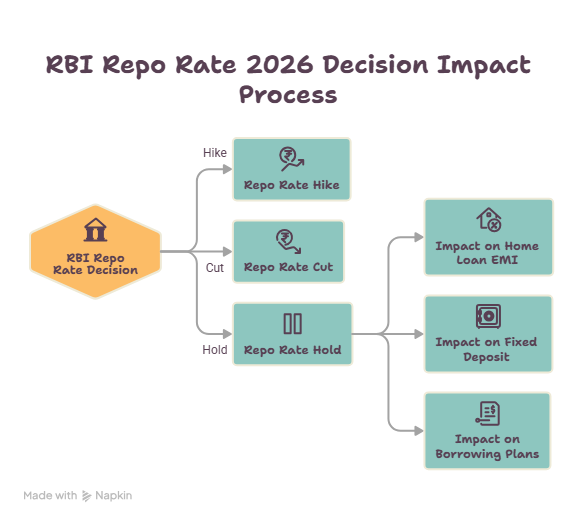
The repo rate is the rate at which the RBI lends short-term funds to commercial banks. It sits at the centre of India’s interest rate system — nearly every other rate in the economy, from your home loan EMI to your fixed deposit return, is influenced by where the repo rate stands.
When the RBI raises the repo rate, banks’ own borrowing costs go up, and they typically pass this on through higher lending rates. When the RBI cuts the repo rate, borrowing becomes cheaper across the system. A hold means neither of these things happens — rates stay exactly where they are until the next policy review.
The Monetary Policy Committee’s decision to hold, rather than act, generally comes down to needing more clarity on the inflation trend before making a move. Inflation moving above the RBI’s medium-term comfort zone but driven mainly by food and fuel prices rather than a broad-based increase across the economy is typically the kind of situation where the central bank prefers to wait and watch rather than react early.
At the same time, the RBI’s own growth outlook for the economy has stayed resilient, which reduces the urgency to cut rates to stimulate activity. A hold, in that context, reflects a central bank that sees no immediate need to move in either direction.
Not every borrower feels a repo rate hold or a future rate change the same way. It depends on which lending regime your loan is linked to.
| Regime | When It Applied | How Fast Rate Changes Reach Your EMI |
|---|---|---|
| Base Rate | Loans taken before 2016 | Very slow, bank discretion |
| MCLR (Marginal Cost of Funds based Lending Rate) | Loans taken between 2016 and 2019 | Slower — can take 6 to 12 months to reflect |
| EBLR (External Benchmark Lending Rate) | Loans taken from October 2019 onward | Fast — usually reflects within 1 to 3 months |
If your loan is still on the older MCLR regime, you may be paying a higher effective rate than a new borrower on EBLR for a similar risk profile. Switching from MCLR to EBLR typically involves a one-time conversion fee, but can be worth it if you have several years left on your loan tenure.
Your EMI stays exactly where it is. There’s no immediate relief, but there’s also no increase. If your loan is on EBLR, this stability should already be visible in your last few EMI statements.
Lending rates across banks remain broadly where they’ve been over recent cycles. This is a reasonable window to compare offers and negotiate spreads with your bank — that process doesn’t need to wait for the next RBI policy meeting.
FD rates typically don’t move ahead of a rate change, and banks have little incentive to raise them during a hold. If you’re planning to park funds in a fixed deposit, locking a longer tenure now secures today’s rate rather than waiting on a rise that current conditions don’t support.
Interest rate stability tends to reduce volatility in debt fund NAVs, since bond prices react most sharply to rate changes rather than to a status quo. A hold generally supports steadier, more predictable returns in this category compared to a period of active rate movement.
| Scenario | Direction of Change | Effect on Floating EMI | Effect on FD Returns |
|---|---|---|---|
| Repo rate hold (current) | No change | EMI stays the same | FD rates broadly stable |
| Repo rate cut | Decrease | EMI falls (EBLR loans, within 1–3 months) | FD rates tend to fall |
| Repo rate hike | Increase | EMI rises (EBLR loans, within 1–3 months) | FD rates tend to rise |
If you have surplus funds and a long remaining tenure, prepaying against your loan principal reduces your interest burden regardless of what the RBI does at its next meeting. Waiting on a cut that may not materialise this year can mean paying more interest than necessary in the meantime.
A rate hold doesn’t guarantee an FD rate increase — in most cases, it signals stability rather than an upward move. Investors waiting for better FD rates before locking in funds may end up parking cash in low-yield instruments for longer than needed.
Borrowers on older MCLR-linked loans sometimes assume they’re getting the same benefit from a rate hold as EBLR borrowers. In reality, MCLR-linked rates move more slowly and less transparently, which can mean paying a higher effective rate without realising it.
A repo rate hold, on its own, is not usually a reason to make a major change to an existing financial plan. It’s better read as a signal of predictability — borrowing costs are unlikely to change sharply in the near term, and FD returns are unlikely to improve significantly either. Investors and borrowers who use this stability to review their loan structure, compare their lending regime, or reassess their fixed-income allocation tend to be better positioned than those waiting for the next policy announcement to act.
 Talk to us
Investor Grievance
Talk to us
Investor Grievance


