
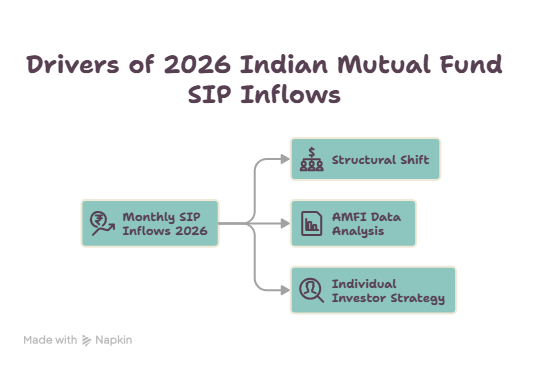
Monthly SIP inflows into Indian mutual funds have stayed at multi-year highs through most of 2026, even as equity markets moved through periods of volatility. This consistency is not accidental it reflects a structural shift in how Indian households are choosing to invest. This article breaks down what’s actually driving the SIP inflows 2026 trend, what the underlying AMFI data reveals, and how an individual investor should read it.
SIP inflows represent recurring monthly commitments into mutual fund schemes, as opposed to one-time lump sum investments. Because the amount is fixed and automated, SIPs remove the temptation to time the market investors keep contributing whether the market is up or down that month.
A few factors are behind the sustained rise in monthly SIP inflows India has seen this year:
The SIP stoppage ratio compares the number of SIPs discontinued or matured in a month against new SIP registrations in that same month. A lower stoppage ratio signals that investors are staying invested rather than exiting early, while a higher ratio can point to reduced confidence or short-term profit booking.
Through 2026, the SIP stoppage ratio has trended lower compared with the same period in prior years, even during months of market volatility. This is one of the more meaningful signals in the data, because it reflects investor behaviour rather than just the size of inflows.
AMFI’s monthly data breaks equity inflows down by category, and 2026 has shown a distinct tilt:
| Category | Investor Appetite in 2026 | What It Signals |
|---|---|---|
| Small-cap funds | High inflows | Investors chasing higher growth potential, accepting higher volatility |
| Mid-cap funds | Steady inflows | Balanced approach between growth and relative stability |
| Large-cap funds | Mild outflows in several months | Investors rotating out of large caps in favour of higher-growth categories |
| Flexi-cap / multi-cap funds | Resilient inflows | Preference for fund-manager discretion across market caps |
This tilt toward small and mid-cap categories is worth noting, but it isn’t, by itself, a signal for every investor to follow. These categories carry meaningfully higher volatility, and allocation should be based on individual risk capacity and investment horizon — not on where the broader market’s money happens to be flowing that month.
A common question that comes up alongside every SIP inflows update is whether SIP or lump sum investing works better in the current market. There’s no universal answer, but the comparison below outlines how each behaves in different conditions.
| Factor | SIP | Lump Sum |
|---|---|---|
| Market timing risk | Averaged out over time | Concentrated at entry point |
| Best suited for | Regular income earners, long-term goals | Investors with a large one-time surplus |
| Behavioural discipline | Built into the structure (automated) | Requires investor conviction to hold |
| Performance in volatile markets | Rupee-cost averaging smooths entry price | More sensitive to timing the entry correctly |
| Ideal holding period | Medium to long term (5+ years) | Medium to long term (5+ years), but timing matters more |
For most retail investors without a large lump sum available, and especially first-time investors, SIPs remain the more practical route because they don’t require predicting market direction.
Just because small-cap or mid-cap funds are attracting the bulk of monthly inflows doesn’t mean they suit every portfolio. Allocation should follow your own goals, not the crowd’s monthly preference.
A single month of muted or negative returns is not a reason to stop a SIP. The entire premise of systematic investing is to average out entry costs across market cycles — stopping midway defeats that purpose.
A rising inflow number can mask a rising stoppage ratio if you don’t look at both together. Understanding investor behaviour requires looking past the headline crore figure.
Whether to increase your SIP contribution depends on your income growth, existing goal-based allocations, and current portfolio diversification — not on the aggregate industry trend. That said, a step-up SIP (where the contribution amount increases annually in line with income) is a commonly used strategy to keep pace with both inflation and rising financial goals over time.
Reviewing your fund selection periodically rather than only your contribution amount also matters. A fund that suited your risk profile three years ago may no longer be the right fit today, particularly if your goals or time horizon have shifted.
 Talk to us
Investor Grievance
Talk to us
Investor Grievance


