
NRI taxation in India is governed by three separate frameworks income tax law, FEMA, and bilateral tax treaties and the rules for each don’t always move in sync. Residential status is the starting point: get that right and everything else follows a clear sequence: what’s taxable, how your accounts should be set up, whether a treaty helps, and whether you need to file at all.
If you have rental income from property in India, an NRO account earning interest, or Indian shares you’ve recently sold, at least one of these areas applies to you directly. Here’s how they work.
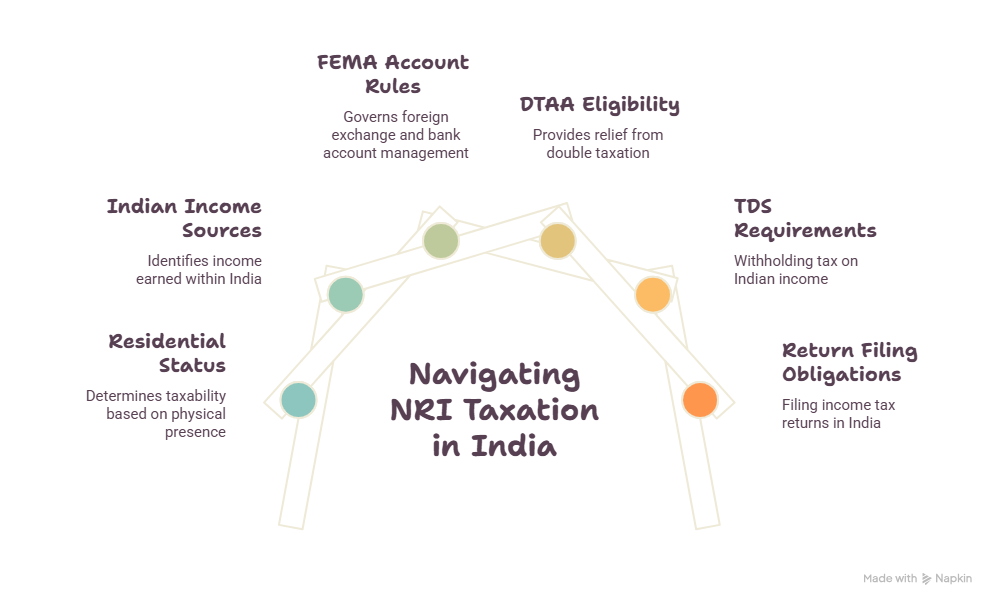
Here’s what determines your status, which income is taxable, how NRE and NRO accounts differ, when a tax treaty actually helps, and when you need to file a return.
Your passport, citizenship, or where your employer is based don’t settle this. Indian income tax residency is determined under Section 6 of the Income Tax Act, and it comes down to how many days you’ve physically been in India during the financial year.
The basic test: you’re treated as a resident if you spent 182 days or more in India during the year, or 60 days or more in the year and 365 days or more across the preceding four years.
There are exceptions. Indian citizens and Persons of Indian Origin visiting India may have the 60-day test replaced by 120 days or 182 days, depending on Indian income levels and other conditions.
Once the test is applied, you fall into one of three categories:
One thing that catches people off guard: this is checked every single year. If your travel pattern changes more time in India than usual your status can shift and so can your obligations.
As a non-resident, the broad principle under Section 5 of the Income Tax Act is that income received in India, deemed to be received in India, or income that accrues or arises in India may be taxable here. Foreign income stays out of scope.
The categories that come up most often:
Income tax residency and FEMA residency are not the same this is one of the most common sources of confusion for NRIs. The Income Tax Act looks at days of physical stay in India. FEMA looks at whether you’ve been resident in India for more than 182 days during the preceding financial year, with its own carve-outs.
The accounts available to NRIs exist because of FEMA rules, and each has different tax and repatriation treatment:
NRE Account (Non-Resident External): Holds foreign income remitted to India, maintained in rupees. Balances are fully repatriable. Interest may be exempt from Indian income tax under Section 10(4)(ii).
NRO Account (Non-Resident Ordinary): Used to manage income earned in India rent, dividends, pension, local receipts. Interest is taxable. Repatriation is permitted up to USD 1 million per financial year, subject to documentation, taxes, and applicable conditions.
FCNR(B) Account (Foreign Currency Non-Resident Bank): Deposits maintained in a permitted foreign currency. Repatriable in accordance with account rules.
A quick comparison:
| Feature | NRE Account | NRO Account | FCNR(B) Account |
|---|---|---|---|
| Currency | Indian Rupees | Indian Rupees | Foreign currency |
| Used for | Foreign income remitted to India | Indian income (rent, dividends, pension) | Foreign currency deposits |
| Interest taxable? | May be exempt (Sec 10(4)(ii)) | Yes, taxable in India | Check applicable rules |
| Repatriable? | Fully repatriable | Up to USD 1 million/year (with conditions) | Repatriable per account rules |
If you return to India and your FEMA status changes, your account classification may need to change with it. NRE or FCNR(B) accounts appropriate while you were non-resident may need to be redesignated once you settle back.
If you have income connected to India that’s also reportable in your country of residence, you may be paying tax in two places on the same amount. That’s where a Double Taxation Avoidance Agreement comes in.
India has DTAAs with a large number of countries. The Income Tax Department publishes the full list and treaty text. These treaties generally work in one of two ways: income is taxed only in one country, or it’s taxed in both but you can claim a foreign tax credit for tax paid in the other jurisdiction.
Claiming treaty benefits isn’t automatic. You need a Tax Residency Certificate from your country of residence. Where the TRC doesn’t contain certain prescribed details, Form 10F under Rule 21AB fills the gap.
A few things to keep in mind:
The short answer: it depends on whether you have taxable Indian income and whether you cross the filing threshold.
Under Section 139 of the Income Tax Act, a return is generally required when total income exceeds the maximum amount not chargeable to tax, before factoring in specified exemptions or deductions. The Income Tax Department also notes that non-residents may need to file if they have income taxable under Indian law or an applicable DTAA.
Filing is also worth doing even when TDS has already been deducted in three specific situations:
For AY 2026-27, most NRIs use ITR-2 applicable for income from salary, house property, capital gains, or other sources where no business or professional income is involved. ITR-3 becomes relevant where business income is part of the picture. Always verify the correct form against the Income Tax Department’s current instructions before filing.
Tax slabs for non-resident individuals apply the same progressive structure as for residents, but without certain exemptions that residents can claim. The Income Tax e-filing portal provides updated slab information for AY 2026-27 specifically for non-resident individuals.
A few things hold steady across years:
This checklist is for general understanding only. It should not be treated as tax, legal, or investment advice.
| Area to Review | Why It Matters |
|---|---|
| Residential status | Determines whether you’re resident, RNOR, or non-resident for tax purposes |
| Indian income sources | Identifies salary, rent, interest, capital gains, or other income taxable in India |
| TDS deducted | Reconcile amounts deducted against AIS and Form 26AS before filing |
| NRE, NRO, FCNR accounts | Different accounts carry different tax and repatriation treatment |
| DTAA eligibility | Check whether a treaty applies and which income types it covers |
| TRC and Form 10F | Required documentation for claiming treaty benefits |
| Capital gains | Classify by asset type and holding period; check withholding requirements |
| Return filing | Confirm whether filing is required and select the correct ITR form |
| Foreign assets | Schedule FA in ITR-2 applies to ROR individuals only; NR and RNOR are not required to fill it |
Coming back to India affects your income tax position and your FEMA status but not always at the same time.
On the income tax side, a returning NRI typically moves through RNOR before becoming fully Resident and Ordinarily Resident. During the RNOR phase, certain foreign income may not be taxable in India the rules are more lenient than they become once you hit full ROR status. How quickly you transition depends on your history of prior stays in India and other conditions under Section 6.
On the FEMA side, once you return with the intention to stay, your non-resident status changes and so does your account treatment. NRE and FCNR(B) accounts may need to be redesignated or managed in line with updated RBI guidelines. Doing a bank account review alongside your tax review in the year of return avoids problems later.
NRI taxation in India isn’t a single rule it’s a framework with three moving parts. The sequence is: determine residential status first, then review Indian income sources, then look at account classification and DTAA eligibility, then confirm TDS and return filing requirements.
FEMA and income tax law overlap but don’t mirror each other. DTAA may reduce your tax burden but requires documentation and treaty-specific analysis for each income type. And even where TDS has already been deducted, filing a return can still be worthwhile particularly if excess tax was deducted or if you have losses to carry forward.
For individual cases, the right reference points are official sources from the Income Tax Department, CBDT, RBI, and the Ministry of Finance. A professional review is advisable before making any compliance or tax decision where your position isn’t clear-cut.
For those looking beyond compliance to actively grow their India-linked wealth, see our guide on Investment Options in India for NRIs (2026), covering fixed deposits, mutual funds, real estate, NPS, bonds, and GIFT City routes.
 Talk to us
Investor Grievance
Talk to us
Investor Grievance


