When Should You Start Planning for Your Retirement?
Planning for retirement is a subject most working professionals in India intend to address at some point. The challenge is that “some point” often arrives much later than it should. Unlike countries with universal pension systems, India does not provide a government-backed
An income guarantee for most private sector workers after retirement. This means individuals must independently build a corpus large enough to sustain their post-retirement life. The question of when to start has a straightforward answer: as early as possible, and ideally from the day you draw your first salary.
Why Starting Early Makes a Difference
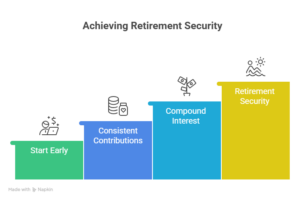
The core reason early retirement planning matters is compound interest. When your savings generate returns that are themselves reinvested and earn further returns, your money grows at an accelerating pace over time. The longer the investment horizon, the more pronounced this effect becomes.
This principle applies uniformly across instruments such as EPF, PPF, NPS, and equity mutual funds. A person who begins contributing modest amounts in their mid-twenties will, in most scenarios, accumulate significantly more than someone who starts contributing larger amounts a decade later, because time in the market is a critical variable. The compounding benefit is maximised only when contributions begin early and continue consistently.
What the Right Move Looks Like at Each Stage of Your Career
Your 20s: The Longest Compounding Runway You Will Ever Have
Your twenties represent your highest-leverage window for retirement. Your absolute savings amount may be modest, but the time available for those savings to compound is at its longest. The instruments worth activating now are:
- Begin contributing to your EPF account, which your employer must maintain if your organisation employs 20 or more people. Employee and employer each contribute 12% of your basic salary and dearness allowance. The current EPF interest rate for FY 2025-26 is 8.25% per annum, as declared by EPFO.
- Open a National Pension System (NPS) Tier-I account. Under the old tax regime, contributions qualify for deduction under Section 80CCD(1) within the overall Rs. 1.5 lakh limit under Section 80C, and an additional deduction of up to Rs. 50,000 under Section 80CCD(1B) over and above this limit.
- Consider a PPF account as a government-backed, long-term savings instrument. The PPF interest rate for FY 2025-26 is 7.1% per annum, as announced by the Finance Ministry. PPF enjoys EEE (Exempt-Exempt-Exempt) status, meaning contributions, interest, and maturity proceeds are all tax-free. The scheme has a 15-year lock-in and allows annual deposits of up to Rs. 1.5 lakh.
- Secure adequate term life insurance and health insurance. Premiums are considerably lower at younger ages.
With a long investment horizon ahead, individuals in this phase may choose a higher proportion of equity in their portfolio, consistent with their personal risk tolerance. It is important to assess risk appetite individually rather than follow a blanket allocation.
Your 30s: Higher Income, More Competing Demands, Smaller Margin for Error
Your thirties typically bring higher income alongside new financial commitments such as home loans, children’s education needs, and responsibilities toward ageing parents. Retirement planning can easily get deprioritised during this phase. It is worth being deliberate about protecting your retirement contributions.
Where to focus your attention:
- Review your EPF and NPS balances annually to assess whether your savings trajectory aligns with your retirement goals.
- Maximise your Section 80C deductions (up to Rs. 1.5 lakh) through eligible instruments such as EPF contributions, PPF, ELSS, life insurance premiums, or home loan principal repayment.
- If your employer offers NPS contributions, the employer’s share is deductible under Section 80CCD(2), separate from the Rs. 1.5 lakh Section 80C limit, and available under both tax regimes. However, the applicable limit differs by regime: under the old tax regime, private sector employees can claim up to 10% of basic salary and dearness allowance, while government employees can claim up to 14%. Under the new tax regime, the limit is a uniform 14% for all employees both private sector and government effective FY 2025-26.
- Consider estimating how large a corpus you will need at retirement. A commonly referenced financial planning approach is to target a corpus equivalent to 25 to 30 times your projected annual expenses at the time of retirement. This is a general framework used by financial planners, not a guarantee. Individual requirements vary based on lifestyle, health, inflation over your specific timeline, and other income sources such as rental income or pension.
- Increase SIP amounts proportionally when your income grows rather than expanding discretionary spending at the same rate.
Your 40s: The Last Comfortable Window to Close Any Gap
Your forties represent the last window where meaningful course correction is practical. If you have accumulated less than planned, this decade calls for more structured action.
What this decade demands:
- Maximise all available tax-advantaged instruments: EPF, PPF (up to Rs. 1.5 lakh per year), NPS (including the additional Rs. 50,000 deduction under Section 80CCD(1B) under the old regime), and ELSS.
- Work toward clearing high-interest liabilities. Outstanding personal loans and credit card debt at high interest rates erode your net worth more quickly than most investment instruments can compensate for.
- Review your asset allocation. As retirement approaches, many financial planners recommend gradually reducing the proportion of equity and increasing the proportion of debt-oriented instruments. The appropriate pace of this shift depends on your individual risk tolerance, retirement timeline, and income stability.
- Reassess your health insurance coverage. Post-retirement medical expenses are a significant and often underestimated component of retirement planning in India. Securing adequate coverage while you are still employed and in good health is generally more cost-effective than doing so later.
Your 50s: Stop Building, Start Planning What You Will Actually Live On
The focus in your fifties shifts from growing your corpus to protecting it and planning how it will be drawn down in retirement.
Key decisions at this stage:
- Progressively move your portfolio toward a more conservative asset allocation as your retirement date approaches.
- Plan your post-retirement income sources. Options include Systematic Withdrawal Plans (SWP) from mutual funds, the Senior Citizens’ Savings Scheme (SCSS), annuity products from life insurance companies, and the NPS annuity. At NPS maturity, up to 60% of the corpus can be withdrawn as a lump sum, of which this portion is tax-free. The remaining 40% must be used to purchase an annuity, and the annuity income received is taxable as per your applicable income tax slab.
- Ensure nominee details across all investment accounts are current and correctly documented.
- Consult a qualified financial planner to model withdrawal sequencing, which involves determining which accounts to draw from first to manage tax liabilities and preserve the corpus for as long as possible.
Key Retirement Instruments in India: A Reference Overview
| Instrument |
Who It Is For |
Interest / Return |
Tax Status |
| EPF |
Salaried employees in eligible organisations |
8.25% p.a. (FY 2025-26) |
EEE up to Rs. 2.5 lakh annual contribution |
| PPF |
All individuals |
7.1% p.a. (FY 2025-26) |
EEE fully |
| NPS |
All citizens aged 18-70 |
Market-linked |
Partial tax-free at exit (60% lump sum) |
| ELSS Mutual Funds |
Risk-tolerant investors |
Market-linked |
LTCG above Rs. 1.25 lakh taxed at 12.5% |
| SCSS |
Senior citizens (60+) |
Set quarterly by government |
Taxable interest; 80C benefit on investment |
| Annuity Plans |
Post-retirement income seekers |
Fixed, varies by provider |
Annuity income fully taxable |
Common Gaps in Retirement Planning
Treating EPF as a complete retirement strategy. EPF is a foundational instrument but, but depending on your salary level and career length, it may not be sufficient on its own to replace a meaningful proportion of pre-retirement income across 25 to 30 post-retirement years.
Underestimating medical expenses. Healthcare costs in India have risen significantly in recent years. Not accounting adequately for medical expenses, particularly in the later years of retirement, is a gap that affects many retirement plans.
Delaying without a concrete reason. The opportunity cost of delay is real in compounding-based instruments. Each year of delay reduces the compounding period available to you.
Not reviewing the plan. A retirement plan drawn up in your thirties may not reflect your actual financial situation or goals in your forties. Annual reviews allow for adjustments based on income changes, life events, and market conditions.
Don’t leave your retirement to chance. Book a free consultation with Right Horizons today.

 Talk to us


